

Rubber Band Quality Inspection: AQL and Defect Criteria
Time : Oct 16, 2026 View : 14
Rubber band quality inspection is essential for buyers that require consistent dimensions, elasticity, durability, and appearance across production lots. A structured inspection process helps purchasing and quality teams apply AQL sampling correctly, classify defects, and make consistent pass-or-reject decisions before goods enter inventory.
For rubber bands, visual inspection alone is rarely sufficient. A lot may look uniform while containing variations in width, thickness, tensile performance, odor, surface finish, or recovery after stretching. The inspection plan should therefore connect sampling rules with measurable specifications and clearly documented acceptance criteria.
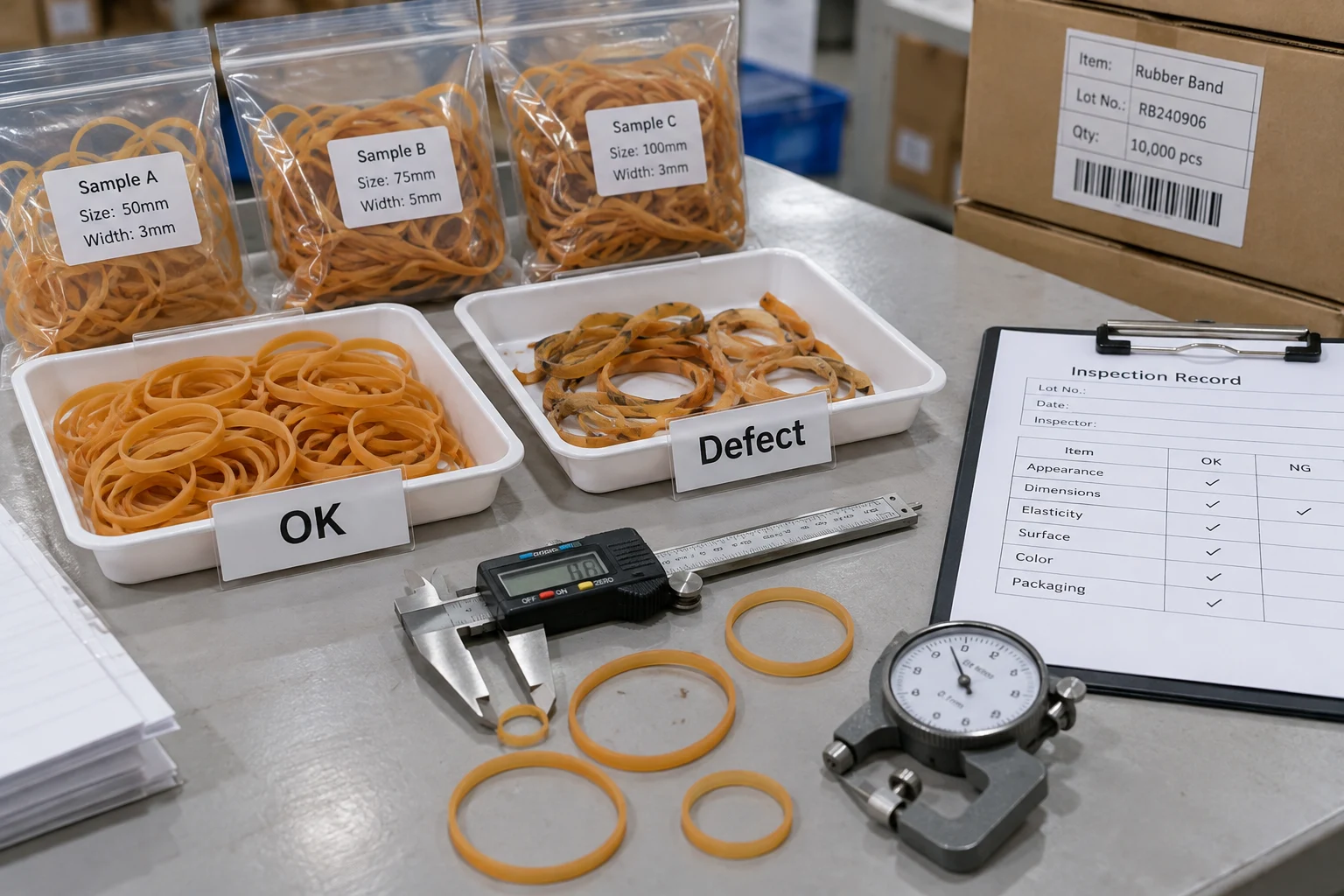
Why Rubber Band Inspection Needs a Lot-Based System
Define the inspection lot before sampling
An inspection lot should represent products made under reasonably consistent conditions. The lot may be defined by production date, material batch, size, color, packaging format, or purchase order line. Mixing different sizes or material formulations into one lot can hide variation and make the sampling result difficult to interpret.
The inspection unit should also be defined. Depending on the packaging method, it may be one rubber band, one retail pack, one inner carton, or one master carton. Dimensional and performance tests normally use individual bands, while packaging checks may use packed units.
A lot-based approach creates a repeatable quality record. It also allows the purchasing team to compare results between first samples, pre-shipment inspections, and repeat orders.
Separate inspection stages
A practical quality plan normally includes three stages:
- Pre-production approval:confirm material, color, dimensions, packaging, and reference samples.
- In-process monitoring:verify that production remains within the approved specification.
- Incoming inspection:evaluate the finished lot before release to a warehouse or distribution channel.
AQL sampling is mainly used for finished-lot decisions. It does not replace process control or product-development testing.
How AQL Sampling Works for Rubber Bands
Set the sampling parameters
AQL sampling usually relies on four decisions:
- Lot size
- Inspection level
- AQL value for each defect class
- Accept and reject numbers from the selected sampling plan
The sample size is selected from the lot size and inspection level. The AQL value then determines how many defects can be found before the lot reaches the rejection threshold. The acceptance number and rejection number must come from the applicable sampling table rather than being invented for a single shipment.
AQL is not a statement that a lot is “allowed” to contain a fixed percentage of defective products. It is a statistical sampling framework for making a release decision from a limited number of inspected units. The purchase specification should still define which defects are unacceptable and which tests are mandatory.
Use separate AQL categories
Critical, major, and minor defects should not be combined into one general count. A rubber band with a safety-related contamination issue is materially different from a band with a small cosmetic mark.
A typical inspection record should show:
|
Inspection category |
Typical examples |
Acceptance approach |
|
Critical |
Foreign material, dangerous contamination, or a condition that creates an unacceptable safety risk |
Normally zero tolerance, subject to the approved specification |
|
Major |
Breakage at normal use, incorrect size, severe surface damage, poor elasticity, or wrong material/color |
AQL level defined in the purchase agreement |
|
Minor |
Light cosmetic marks, small shade variation, or limited packaging imperfections |
Separate AQL level and visual standard |
The final values should reflect the product application, destination-market requirements, packaging claims, and buyer risk tolerance.
Rubber Band Defect Types to Classify
Critical defects
Critical defects can create safety, contamination, or regulatory concerns. Examples may include visible foreign material embedded in the rubber, sharp unwanted protrusions, chemical contamination, or a material mix-up that conflicts with the approved specification.
A critical-defect decision should be linked to the product’s application and market requirements. A rubber band intended for general bundling may have a different risk profile from one supplied in a consumer pack or used near food packaging.
Major defects
Major defects are likely to affect function, appearance, customer acceptance, or repeat-order performance. Common examples include:
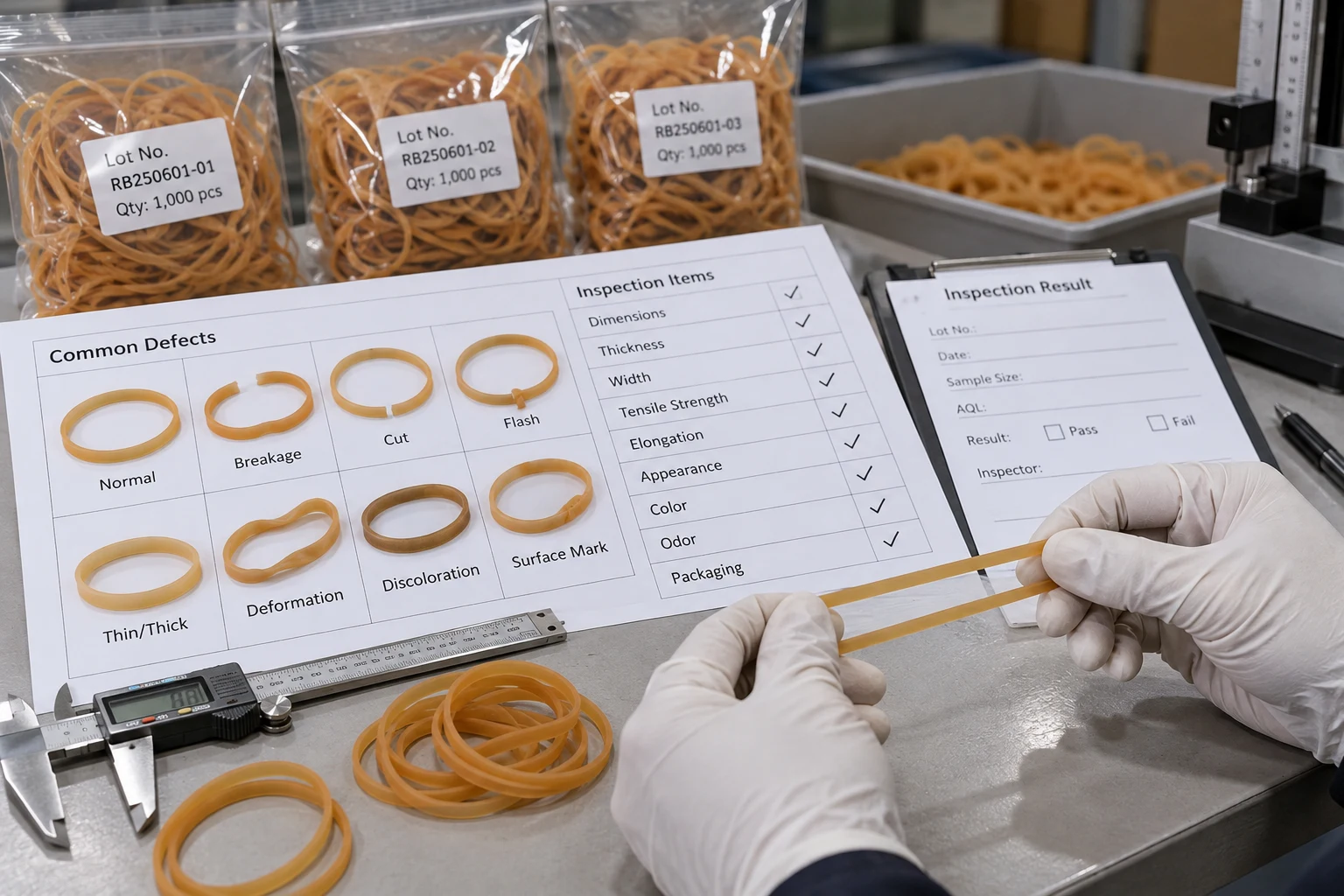
- Breakage during the specified stretch test
- Incorrect internal diameter, width, or thickness
- Permanent deformation after stretching
- Excessive flash, cracks, cuts, or weak joints
- Large color deviation from the approved sample
- Uneven cross-section affecting application performance
- Strong or abnormal odor that conflicts with the specification
- Incorrect count or product identification on the package
For dimensional defects, the tolerance should be written in the purchase specification. A general statement such as “standard size” is difficult to enforce during incoming inspection.
Minor defects
Minor defects do not normally prevent use but can reduce visual consistency or retail readiness. Examples include small surface marks, limited color variation within an approved range, minor print misalignment, or light packaging scuffing.
Minor defects still need boundaries. Without a visual limit or reference sample, different inspectors may classify the same condition differently. A defect photo sheet or sealed approval sample can improve consistency.
What to Inspect on Each Sample
Dimensional and appearance checks
The inspection should verify the dimensions that influence fit and performance:
- Internal diameter or relaxed length
- Band width
- Band thickness
- Cross-section uniformity
- Color and surface finish
- Flash, cracks, cuts, bubbles, and embedded particles
Measurement tools should be suitable for the tolerance. Calipers, thickness gauges, scales, and go/no-go fixtures may be used depending on the product geometry. The method should specify whether measurements are taken in a relaxed state, under a defined load, or after conditioning.
For buyers evaluating multiple rubber-band formats, the rubber-series product category provides a useful reference point for comparing product configurations before finalizing an inspection plan.
Elasticity and recovery checks
Functional testing should reproduce the intended use as closely as possible. A test plan may define:
- Initial relaxed dimension
- Stretch distance or elongation
- Applied force or load
- Hold time
- Number of stretch cycles
- Recovery measurement
- Breakage or surface-damage criteria
A rubber band can pass a simple pull test but still show poor recovery after repeated cycles. For this reason, the method should distinguish between one-time tensile performance and repeated-use behavior.
If a project involves elevated-temperature storage or transport, the specification should identify the required conditioning method and performance limits. A product such as the heat-resistant green rubber band should be evaluated against the actual temperature and application conditions rather than a generic claim.
Rubber Band Acceptance Criteria for Purchase Orders
Build measurable criteria
A purchase order or technical specification should define the release requirements before production begins. A useful acceptance table may include:
|
Characteristic |
Inspection method |
Acceptance criterion |
|
Dimensions |
Caliper, gauge, or approved fixture |
Within agreed nominal value and tolerance |
|
Appearance |
Controlled visual inspection |
No critical defects; major and minor defects classified by reference standard |
|
Elastic performance |
Defined stretch or force test |
Meets the approved force, elongation, recovery, or breakage requirement |
|
Color |
Approved physical sample or color reference |
Within the agreed visual range |
|
Odor and contamination |
Visual and sensory screening where applicable |
No abnormal condition against the agreed specification |
|
Packaging |
Count, labeling, seal, and carton inspection |
Matches approved artwork, quantity, and packing instructions |
Acceptance criteria should identify the test quantity, test environment, equipment, and reporting format. If the product is sold in multiple markets, packaging and labeling requirements should be checked separately from physical-product acceptance.
Link acceptance to disposition
The inspection report should state one of three outcomes:
- Accepted:the lot meets the defined criteria.
- Rejected:the lot exceeds one or more rejection thresholds.
- Conditional review:the lot requires documented concession, sorting, rework, or additional testing.
Conditional release should not become an informal substitute for a clear specification. Any concession should record the affected quantity, defect type, commercial decision, and corrective action.
Incoming Inspection Workflow
Use a repeatable sequence
A practical incoming-inspection sequence is:
- Verify purchase order, lot number, product code, and packaging identity.
- Confirm the lot size and select the sample according to the approved plan.
- Inspect packaging, labels, count, and visible shipping damage.
- Perform dimensional and visual checks.
- Complete elasticity, recovery, or tensile tests where required.
- Classify defects as critical, major, or minor.
- Compare results with the acceptance and rejection numbers.
- Record photographs, measurements, equipment identification, and inspector information.
- Release, reject, sort, rework, or hold the lot.
- Feed recurring defects into supplier corrective action and replenishment reviews.
Sampling locations should be distributed across cartons and production batches when practical. Inspecting only the first carton can miss variation caused by material changes, machine adjustments, or packaging-stage errors.
Supplier Controls for Repeat Orders
Turn inspection data into a specification system
A first-order inspection may confirm whether a shipment is acceptable, but repeat-order control requires trend information. Records should compare dimensional averages, defect frequencies, breakage results, color consistency, and packaging errors between lots.
The purchasing team can also define escalation rules. For example, repeated major defects may trigger a process review, tighter inspection, a revised sampling level, or a requirement for pre-shipment approval. The exact response should be agreed before a quality dispute occurs.
A supplier that can review drawings, reference samples, packaging artwork, and test requirements is better positioned to support consistent replenishment. The VIET-Y product range covers rubber and other elastic material families, so the technical discussion can be organized around the required material, dimensions, application, and inspection method rather than a generic product description.
Conclusion: Make Rubber Band Quality Inspection Repeatable
Connect sampling with measurable performance
AQL sampling is most effective when it is supported by clear lot definitions, defect classifications, dimensional tolerances, functional tests, and documented disposition rules. The inspection plan should separate critical, major, and minor defects and should state how results affect shipment release.
For procurement teams, the goal is not simply to inspect more pieces. The goal is to create a repeatable decision system that protects functional performance, packaging consistency, landed inventory value, and future replenishment.
FAQs
What is AQL sampling for rubber bands?
AQL sampling is a statistical method for selecting and inspecting a defined number of units from a production lot. The lot is accepted or rejected according to the selected inspection level, AQL values, and acceptance or rejection numbers.
Is AQL a guarantee that every rubber band is defect-free?
No. AQL supports a lot-level decision based on sampling. It does not guarantee that every unit is perfect. Critical defects, mandatory performance tests, and specific regulatory requirements may require separate controls.
Which rubber band defects are usually major defects?
Common major defects include breakage during the specified test, incorrect dimensions, severe cracks or cuts, poor recovery, substantial color deviation, wrong material, and packaging errors that affect identification or saleability.
How should rubber band dimensions be measured?
The method should identify the relaxed or loaded condition, measuring tools, sample conditioning, measurement points, and tolerance. Internal diameter, width, thickness, and cross-section uniformity should be measured consistently across the sample.
Should every shipment use the same sampling plan?
The approved plan should remain stable unless the product risk, supplier performance, lot size, destination-market requirement, or quality history changes. Any change should be documented and communicated before inspection.
Request a Rubber Band Quality Inspection Plan
Prepare a review-ready specification brief
VIET-Y is a rubber-products manufacturer and factory that can review a rubber-band project according to its material, dimensions, performance targets, packaging format, and replenishment controls. A useful inquiry should include the application, nominal dimensions and tolerances, color references, elasticity or pull-force target, packaging and labeling requirements, forecast quantity, destination market, OEM/ODM scope, and proposed AQL or acceptance criteria. For sample review, quotation, and a controlled reorder plan, contact the technical team with the available drawings, reference samples, and inspection requirements.

Latest News
-
Jun. 04, 2026TPU Elastics Safety & Compliance for B2B Food and Hygiene Packaging 2026VIET-Y offers high elastic food grade TPU rubber bands with FDA and EU compliance for food and hygiene packaging. Superior durability, abrasion resistance and safety. Contact us for samples and bulk custom solutions.
-
Jun. 04, 2026Customizable Rubber Bands: Key to B2B Organization and Efficiency in 2026VIET-Y specializes in high-elasticity natural rubber bands and customizable elastic bands for B2B logistics, offices, and supply chains. Durable, color-coded solutions with strong rebound deliver reliable performance and workflow efficiency. Contact us for a free quote.
-
May. 28, 2026Reliable Wholesale Rubber Band Suppliers: B2B Sourcing Guide 2026VIET-Y offers reliable wholesale rubber band solutions with strict quality control, OEM/ODM capability, timely delivery, and ISO certification. This B2B sourcing guide helps buyers select trusted suppliers for sustainable supply chains in 2026.


