

Why Rubber Bands Have White Powder: Rubber Bloom Causes
Time : Oct 22, 2026 View : 2
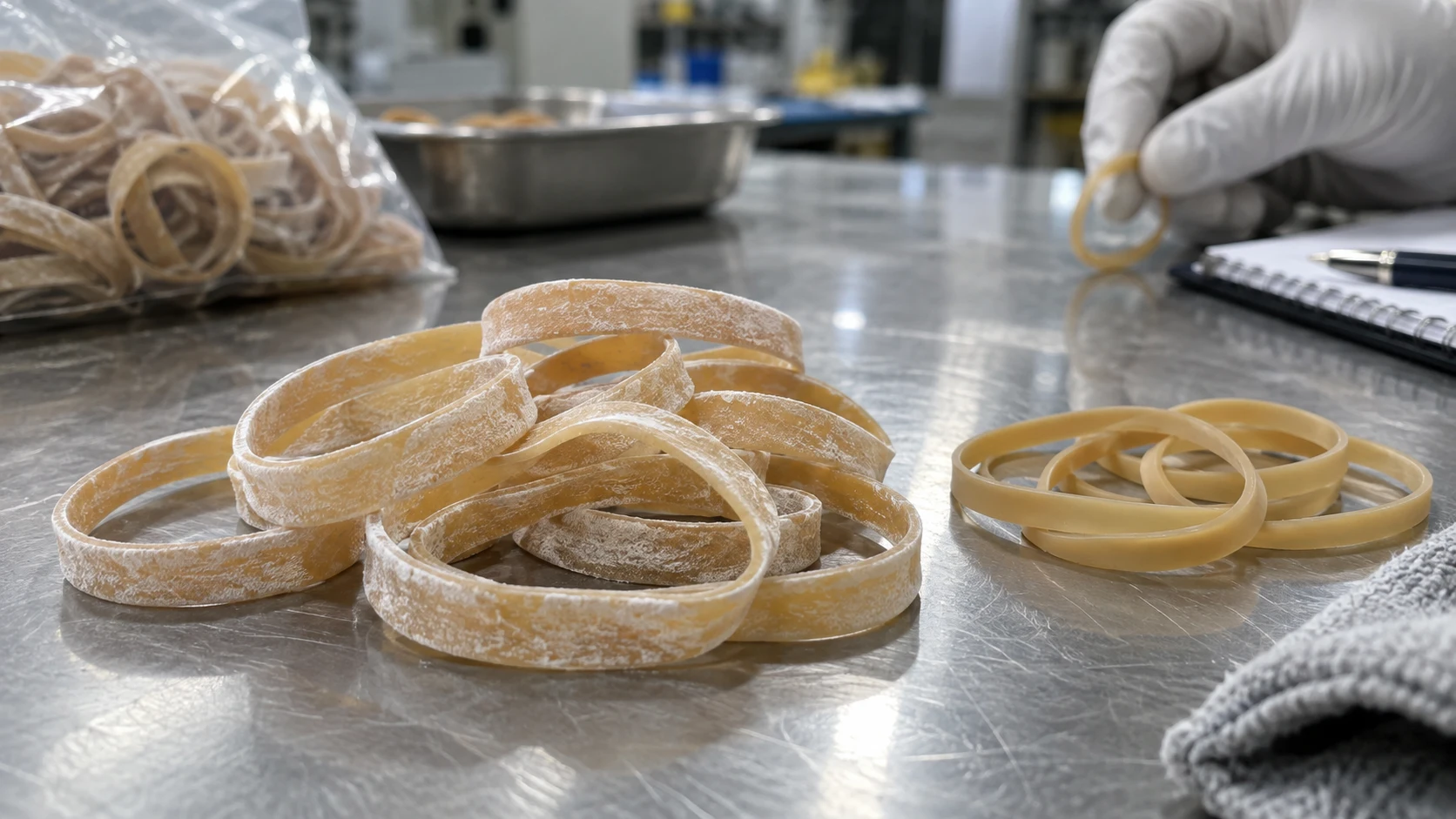
White powder on a rubber band is usually not dust from the warehouse. It is often “rubber bloom”: a compounding ingredient moves from inside the elastomer to the surface and crystallizes or forms a waxy film. A removable surface bloom may be cosmetic, while contamination, mold, over-aging, or an incorrect cure can signal a larger quality problem. Buyers should identify the residue, check the storage and application history, and then confirm the compound and process with the supplier.
What the White Powder Usually Is
It should be noted that rubber is a formulated material, not one single material. Rubber could include the basic polymer, plus sulfur or peroxide vulcanizing agents, accelerators, antioxidants, process aids, pigments, and protective waxes. In case one of the materials exceeds its solubility, is poorly mixed, or decreases its compatibility as rubber ages, this material migrates to the region of low energy. It forms either a white, gray, or light-colored dust, haze, or even waxy film when it gets to the air interface. This effect is called “bloom” or “additive migration.”
The residue is therefore not automatically a sign that a rubber band is unsafe or unusable. Some wax bloom is intentional: the wax forms a protective layer against ozone and oxygen. Other bloom is unwanted because it can transfer to packaging, reduce visual quality, change friction, or make a lot look inconsistent. The correct decision depends on the material, application, and acceptance criteria.
Why Rubber Bands Develop Bloom
Formulation and curing balance
Excess sulfur, peroxide, accelerator, zinc compound, stearate, antioxidant, or processing aid can exceed the compound’s compatibility limit. Inadequate mixing can leave local pockets with a higher concentration. A cure that is too short, too long, or poorly matched to the compound can also leave ingredients available to migrate. These are process and formulation questions, so simply wiping the surface does not remove the underlying cause.
Natural rubber, synthetic rubber, and latex-based bands can show different behavior. Do not infer the compound from appearance alone; ask for the material family and the supplier’s specification.
Heat, humidity, light, and time
Temperature accelerates molecular movement. Repeated heat exposure in a warehouse, container, or production line can make bloom appear sooner. Humidity may contribute to surface changes or packaging condensation, while ultraviolet light, oxygen, and ozone can age the elastomer and alter additive solubility. Long storage gives ingredients more time to reach the surface, even when the original batch looked clean.
Packaging can slow or hide the process. Record lot number, carton position, storage temperature, and whether the film appears on all colors and sizes or only one subgroup.
Bloom, Contamination, Mold, or Degradation?
Use a controlled comparison before rejecting a shipment. Bloom is commonly dry, powdery, or wax-like and can be reduced by a clean wipe. It may return after days or weeks because the source is inside the rubber. Dust is usually loose and uneven, with no consistent film on protected surfaces. Mold tends to show irregular colonies, discoloration, or odor and requires a separate hygiene investigation. Degradation is more concerning when the white surface is paired with cracking, tackiness, loss of rebound, strong odor, or dimensional change.
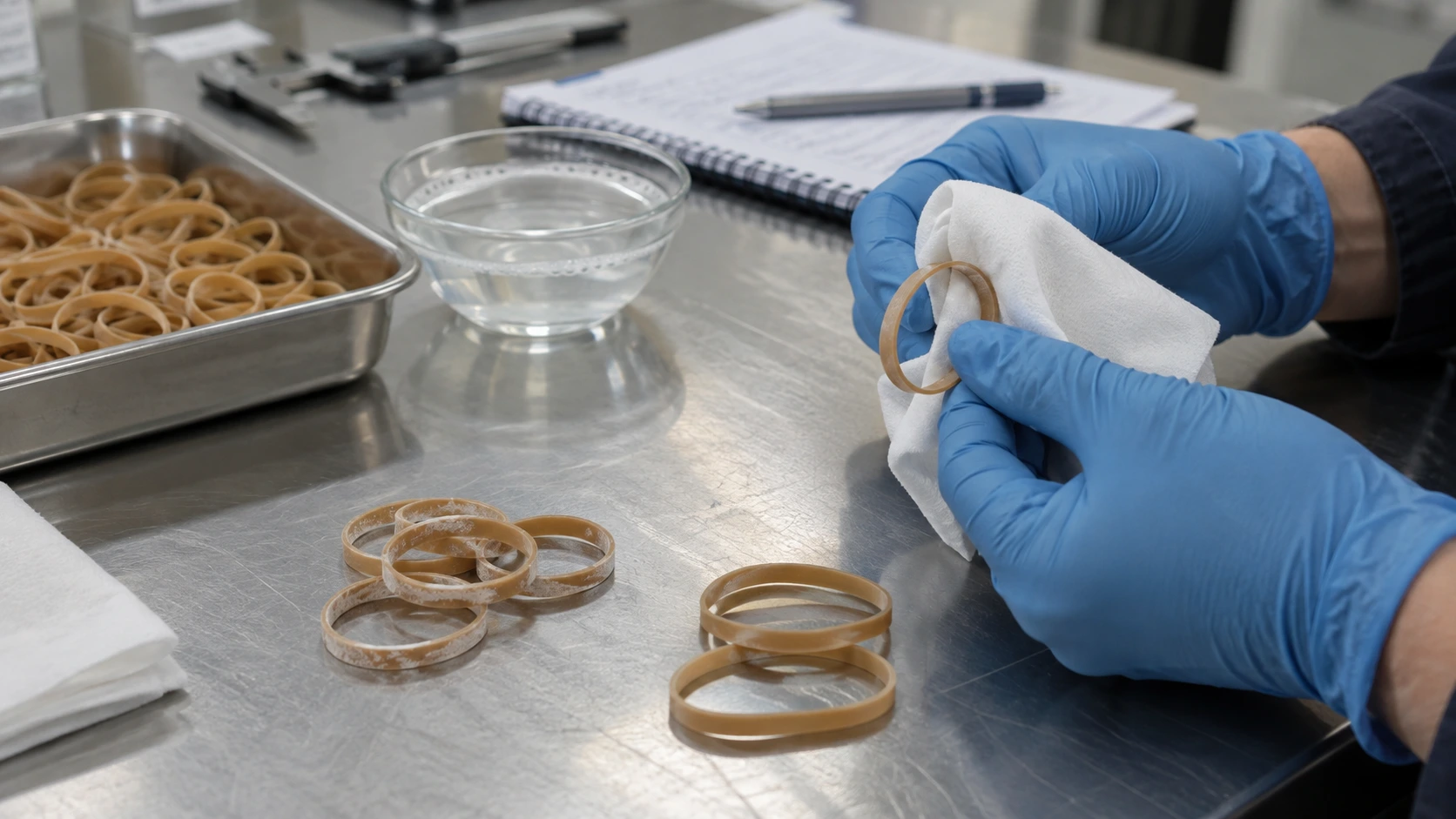
Check an affected band, an unopened same-lot band, an approved sample, and a controlled-storage band. Photograph each before cleaning. Note transfer to a white cloth, response to a mild approved cleaner, and return after conditioning. Do not use solvent, oil, or abrasive powder before comparison; those actions can create a false result.
For incoming inspection, measure flat length, width, thickness, and loop or bundle size. Reproduce the application: stretch, holding time, contact material, temperature, and cycle count. A film followed by cracking or poor recovery is a performance investigation, not a cosmetic complaint.
How to Remove Rubber Bloom Safely
For a non-sensitive general-purpose application, start with the least aggressive method:
- Isolate and photograph the affected lot before cleaning.
- Wipe a small sample with a clean, dry, lint-free cloth.
- If needed, use water or a mild neutral soap solution, then rinse and dry completely.
- Recheck tack, odor, color, rebound, and residue transfer after conditioning.
- Test compatibility before using alcohol, mineral oil, silicone products, or any solvent. The right cleaner depends on the compound and the end use.
Cleaning removes what is already on the surface; it does not correct an unbalanced formula, poor dispersion, or unsuitable storage. If bloom reappears rapidly, quarantine the lot and request a corrective-action review. For sensitive applications, use the approved cleaning and compliance procedure rather than a household recommendation.
How Manufacturers and Buyers Prevent Recurrence
Prevention starts with a controlled specification. Ask the supplier to define material family, color, dimensions, packaging, storage limits, surface condition, and any permitted protective bloom. For repeat orders, retain an approved reference sample.
Useful process controls include accurate weighing, adequate mixing and dispersion, a validated cure window, clean cutting equipment, and lot traceability. Storage controls should limit unnecessary heat, direct sunlight, ozone sources, and incompatible chemicals. Stock rotation reduces aging risk, but it does not replace reinspection.
The buyer’s acceptance plan should distinguish appearance from function. Define whether a light haze is acceptable, whether residue may transfer, and which changes require rejection. Include a wipe test plus a performance check for rebound, working extension, holding force, and breakage under the actual load. If only one color, size, or date blooms, compare its records with a clean control.
What to Include in a Rubber Band RFQ
An RFQ that says only “high-quality rubber bands” leaves bloom risk undefined. Include:
- Material preference or approved alternatives, plus the intended contact environment.
- Flat length, width, thickness, diameter or loop size, color, and tolerances.
- Working stretch, load, holding time, duty cycle, and contact surface.
- Exposure to heat, UV, ozone, water, oils, solvents, cleaners, food, skin, or enclosed packaging.
- Surface limits for powder, wax, tack, odor, color variation, and transfer.
- Packaging format, quantity, delivery location, sample plan, lot identification, and required documents.
VIET-Y’s rubber-band product range and latex-series options show that the company serves multiple elastic-material categories. Its OEM/ODM service information also lists custom support, so an inquiry should include the drawing, material preference, dimensions, color, application conditions, packaging, and test method. These details allow a supplier to separate a formulation issue from a storage or fit issue instead of treating every white mark as the same defect.
If the symptom appears together with stickiness, odor, fading, or breakage, use the broader rubber-band troubleshooting guide to structure the comparison. The focused bloom investigation should remain responsible for the residue itself: identify it, document recurrence, and set a measurable acceptance limit.
Conclusion
Rubber bands have white powder most often because an ingredient has migrated to the surface and formed bloom. The cause may be intentional protective wax, excess or poorly dispersed compounding material, cure imbalance, aging, or an environment that accelerates migration. Wiping can improve appearance, but a lasting solution requires controlled samples, application-specific testing, and a clear supplier specification. VIET-Y can evaluate a request more effectively when it includes material, dimensions, stretch, load, storage, exposure, packaging, quantity, and acceptance criteria. Contact the technical team for a fit and quality review before repeating a disputed order.
FAQs
Is white powder on a rubber band always a defect?
No. It can be a protective wax bloom or a superficial, removable deposit. It becomes a quality concern when it transfers, returns quickly, varies unexpectedly, or appears with cracking, tack, odor, or poor recovery.
Does bloom mean the rubber band will break?
Not by itself. Bloom may be cosmetic, but a shared cause such as aging, cure variation, or chemical exposure can also reduce performance. Compare cleaned and uncleaned samples under the real load and stretch.
How can a buyer prevent white residue in bulk orders?
Specify the material, dimensions, environment, packaging, permitted surface condition, wipe-test method, and performance limits. Approve a retained reference sample and inspect multiple lots after a defined conditioning period.
What should I send a supplier for investigation?
Send photos before cleaning, lot and carton information, affected and control samples, storage history, application conditions, dimensions, and the required surface and performance limits.
For an actionable RFQ or corrective-action review, share the band dimensions, material preference, application, operating environment, packaging, quantity, and any photos or retained samples available.

Latest News
-
Jun. 04, 2026TPU Elastics Safety & Compliance for B2B Food and Hygiene Packaging 2026VIET-Y offers high elastic food grade TPU rubber bands with FDA and EU compliance for food and hygiene packaging. Superior durability, abrasion resistance and safety. Contact us for samples and bulk custom solutions.
-
Jun. 04, 2026Customizable Rubber Bands: Key to B2B Organization and Efficiency in 2026VIET-Y specializes in high-elasticity natural rubber bands and customizable elastic bands for B2B logistics, offices, and supply chains. Durable, color-coded solutions with strong rebound deliver reliable performance and workflow efficiency. Contact us for a free quote.
-
May. 28, 2026Reliable Wholesale Rubber Band Suppliers: B2B Sourcing Guide 2026VIET-Y offers reliable wholesale rubber band solutions with strict quality control, OEM/ODM capability, timely delivery, and ISO certification. This B2B sourcing guide helps buyers select trusted suppliers for sustainable supply chains in 2026.


