

Custom Rubber Band RFQ Checklist: 12 Specifications to Confirm Before Ordering
Time : Oct 15, 2026 View : 0
A custom rubber band RFQ should do more than state a preferred size and quantity. The supplier needs enough information to identify the right compound, calculate the working stretch, confirm production tolerances, and package the order correctly. Missing details often lead to bands that slip, break, take a permanent set, or arrive in a format that does not fit the buyer’s process.
Use the following 12-point checklist before requesting a quotation. It is designed for procurement, packaging, warehouse, office-supply, and light industrial applications where repeatability matters.
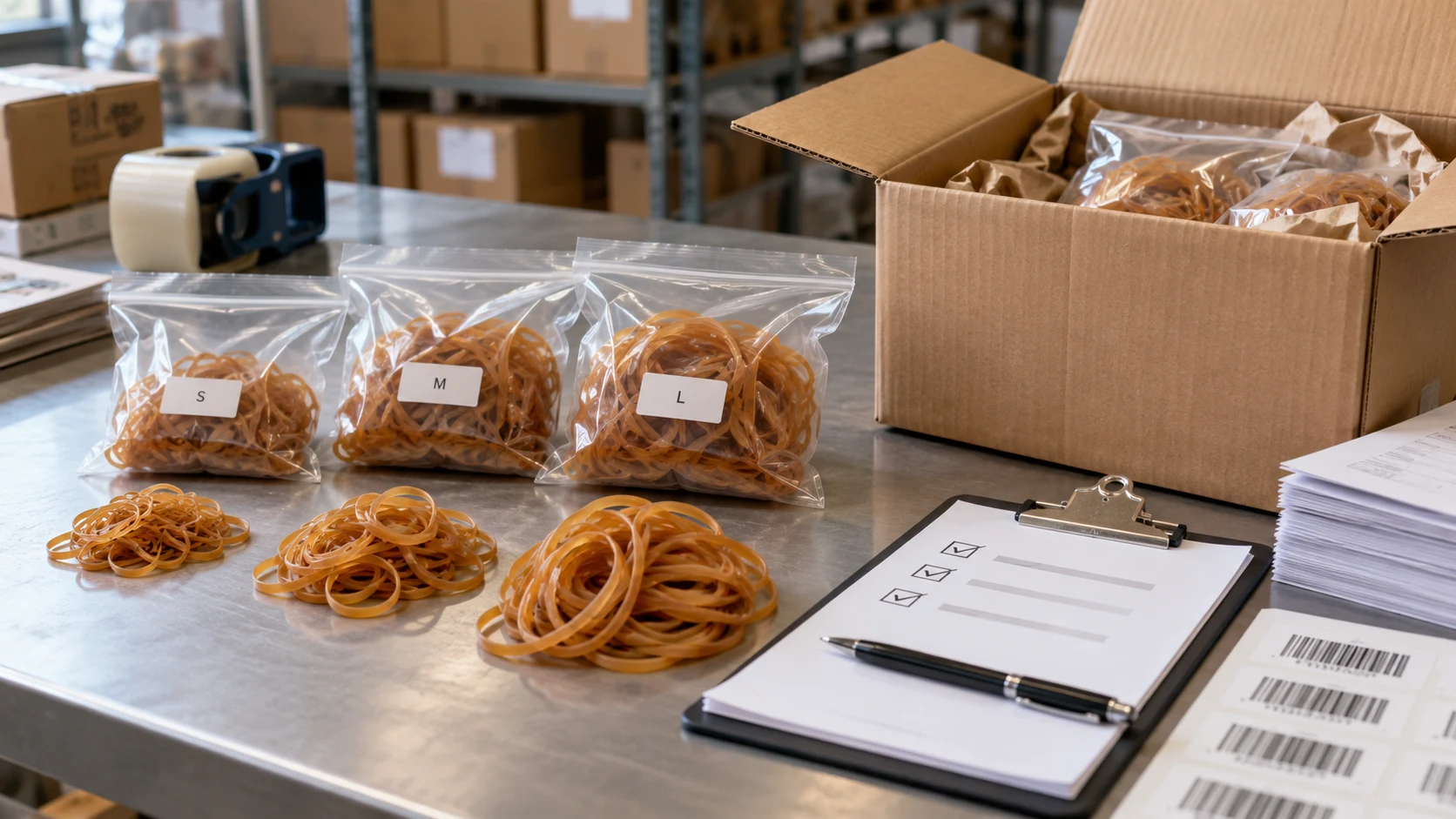
Why a complete RFQ matters
Rubber bands are simple parts, but their behavior depends on several connected variables. A band with the correct relaxed diameter may still be unsuitable if its cross-section is too thin, its working extension is excessive, or its compound does not tolerate the operating environment.
A clear RFQ also makes quotations comparable. Each supplier should be responding to the same dimensions, material expectations, inspection requirements, packaging plan, and commercial assumptions. If a specification is unknown, mark it as “to be recommended” and describe the application instead of leaving the field blank.
The 12-point custom rubber band RFQ checklist
1. Application and function
Explain what the band must do. State whether it will bundle documents, hold packaging, organize components, secure a temporary load, or serve another purpose. Include the object’s shape, approximate weight, surface texture, and whether the band is applied manually or by equipment.
This context helps the supplier distinguish a light-duty organizing band from a product that must maintain tension around irregular or heavier bundles.
2. Product geometry
Describe the items being wrapped or retained. Give the minimum and maximum bundle circumference, the number of layers, and any corners, protrusions, or sharp edges that could contact the band.
A drawing, photograph with dimensions, or sample of the assembled bundle is often more useful than a general phrase such as “large rubber band.” Geometry determines how much the band must stretch and whether a standard loop is practical.
3. Working extension
State the intended installed length or circumference, not only the relaxed size. If the band will be stretched repeatedly, provide the expected extension range and the number of cycles or handling events.
The supplier can then assess whether the band should operate near its comfortable elastic range. A band that is constantly stretched too far may lose tension sooner or fail during application.
4. Relaxed inside length or diameter
Specify how the band will be measured: relaxed inside circumference, relaxed inside diameter, or another agreed method. Do not mix outside diameter, inside diameter, and lay-flat length in the same RFQ.
For custom rubber bands, a simple dimensional sketch should identify the measurement points. If the supplier proposes a standard size, ask for the actual tolerance rather than relying on a nominal catalog label.
5. Width and thickness
Give the band’s cross-section width and thickness, including acceptable tolerances. These dimensions influence contact area, resistance to cutting, stretch behavior, and the amount of force required during application.
If the band must pass through a guide, slot, or automated feeder, include the maximum permitted cross-section. For manual use, explain whether operators need low application force or a stronger grip.
6. Material or compound
Name the preferred material if it is known, such as natural rubber, latex, silicone, EPDM, or another specified elastomer. If the material is not fixed, describe the required properties and any restrictions, including odor, allergy sensitivity, color limitations, or contact with oils.
A current VIET-Y custom natural-rubber band example lists natural rubber and custom size options. Buyers should still request confirmation of the compound for the exact quoted SKU.
7. Hardness and elasticity
Hardness, rebound, and flexibility should be treated as separate requirements. State whether the band must feel soft and easy to apply, resist deformation, or recover quickly after release.
If you have a benchmark sample, send it to the supplier and ask for a comparison. If you specify hardness or another test value, also ask which test method, conditioning, and measurement direction will be used.
8. Tensile strength, elongation, and set
Define the performance measures that matter to the application. These may include tensile strength, elongation at break, force at a working extension, and resistance to permanent set after repeated stretching.
Do not request a high value without explaining the use case. Excessive strength can make a band difficult to apply, while insufficient recovery can cause the band to loosen around the bundle.
9. Temperature and chemical exposure
List the minimum and maximum operating temperatures, storage conditions, sunlight exposure, humidity, and contact with chemicals or oils. Include cleaning agents, adhesives, inks, and packaging materials if they may touch the band.
If the environment is unknown, ask the supplier to identify the limits that must be verified by testing. Material selection should be based on actual exposure rather than a generic “industrial grade” description.
10. Color, finish, and branding
Specify color, opacity, surface finish, and whether color matching is required. Explain whether the color is used for identification, inventory control, branding, or appearance.
If printing, embossing, or a logo is required, provide artwork, print area, orientation, and durability expectations. Confirm whether branding changes the minimum order quantity or requires a separate approval sample.
11. Tolerance, inspection, and documentation
Add dimensional tolerances for inside length or diameter, width, thickness, color, and visible defects. Define the acceptance standard for cuts, flash, cracks, uneven edges, and contamination.
Ask what inspection records can accompany the shipment, such as a dimensional report, material declaration, batch identification, or sample approval record. The supplier and buyer should agree on the inspection basis before production begins.
12. Quantity, packaging, and commercial terms
State the first order quantity, expected annual demand, pack size, carton requirements, labeling, pallet preferences, and destination. Also request the minimum order quantity, sample policy, tooling or setup charges, production schedule, payment terms, and shipping basis.
These details affect the real landed cost. A low unit price may not be useful if the pack size, minimum order, or shipping method does not fit your purchasing system.
How to send an RFQ that suppliers can price accurately
Prepare one concise RFQ document with a specification table, a drawing or photograph, and the application description. Separate confirmed requirements from open questions. For example, you may know the relaxed inside diameter and color but need the supplier to recommend the material and cross-section.

Include the following attachments where available:
- A dimensioned drawing or marked-up photograph
- A sample of the current band or the assembled bundle
- Expected working extension and application method
- Environmental and storage conditions
- Annual volume forecast and first-order quantity
- Packaging, labeling, and destination requirements
Request the quotation in a consistent format. Ask each supplier to identify the proposed material, dimensions, tolerances, test basis, sample requirements, MOQ, and exclusions. This makes it easier to compare technically different offers without focusing only on price.
How VIET-Y can support a custom rubber band RFQ
VIET-Y’s public product range includes rubber and latex series, while its service pages describe ODM/OEM support and customized product handling. Its product information also presents custom size and logo options for selected rubber bands. These capabilities should be confirmed against the exact application, material, and quantity in your RFQ.
For a first discussion, buyers can review the rubber-band product range and the ODM/OEM service information. A related B2B rubber-band applications guide may also help teams describe bundling, warehouse, and office-use scenarios more clearly.
Conclusion
A strong custom rubber band RFQ connects the application to measurable requirements. Confirm the bundle geometry, relaxed and working dimensions, cross-section, material, elasticity, environmental exposure, appearance, inspection method, and commercial details before ordering. When the specification is uncertain, provide the use case and ask the supplier to recommend a controlled option.
This approach reduces quotation ambiguity, improves sample approval, and gives procurement teams a clearer basis for comparing suppliers and managing repeat orders.
For a fit check or quotation, contact the technical team with the required dimensions, material preference, working extension, quantity, operating conditions, drawing or sample details, and packaging expectations.
FAQs
What is the most important specification for a custom rubber band?
The application and working extension are usually the best starting points. They allow the supplier to evaluate size, cross-section, material, and expected recovery together.
Should I specify natural rubber or another elastomer?
Specify the material when environmental or compliance requirements make it necessary. Otherwise, describe the operating conditions and let the supplier recommend a compound for approval.
Do custom rubber bands require a sample?
A sample is strongly recommended when dimensions, stretch behavior, color, or surface finish are critical. It gives both parties a physical reference before mass production.
What should I include in a repeat-order RFQ?
Include the approved drawing, revision number, material, tolerances, packaging instructions, inspection requirements, previous sample reference, quantity, and delivery destination.

Latest News
-
Jun. 04, 2026TPU Elastics Safety & Compliance for B2B Food and Hygiene Packaging 2026VIET-Y offers high elastic food grade TPU rubber bands with FDA and EU compliance for food and hygiene packaging. Superior durability, abrasion resistance and safety. Contact us for samples and bulk custom solutions.
-
Jun. 04, 2026Customizable Rubber Bands: Key to B2B Organization and Efficiency in 2026VIET-Y specializes in high-elasticity natural rubber bands and customizable elastic bands for B2B logistics, offices, and supply chains. Durable, color-coded solutions with strong rebound deliver reliable performance and workflow efficiency. Contact us for a free quote.
-
May. 28, 2026Reliable Wholesale Rubber Band Suppliers: B2B Sourcing Guide 2026VIET-Y offers reliable wholesale rubber band solutions with strict quality control, OEM/ODM capability, timely delivery, and ISO certification. This B2B sourcing guide helps buyers select trusted suppliers for sustainable supply chains in 2026.


