

Rubber Band Tensile Strength Explained: Elongation, Recovery, and Break Tests
Time : Oct 23, 2026 View : 0
The tensile strength of a rubber band is only one factor in determining the performance of the elastic band. The rubber band may have high tensile strength but not much recovery from continuous stretching, or it may be highly stretchable but break easily when subjected to a concentrated load. When evaluating an elastic band, all factors should be taken into consideration.
Such measurements provide answers to practical questions such as whether the band will be able to hold a particular product and restore back to its original shape, whether the lots produced will be uniform, and whether one can compare tests done by the supplier despite varying parameters.
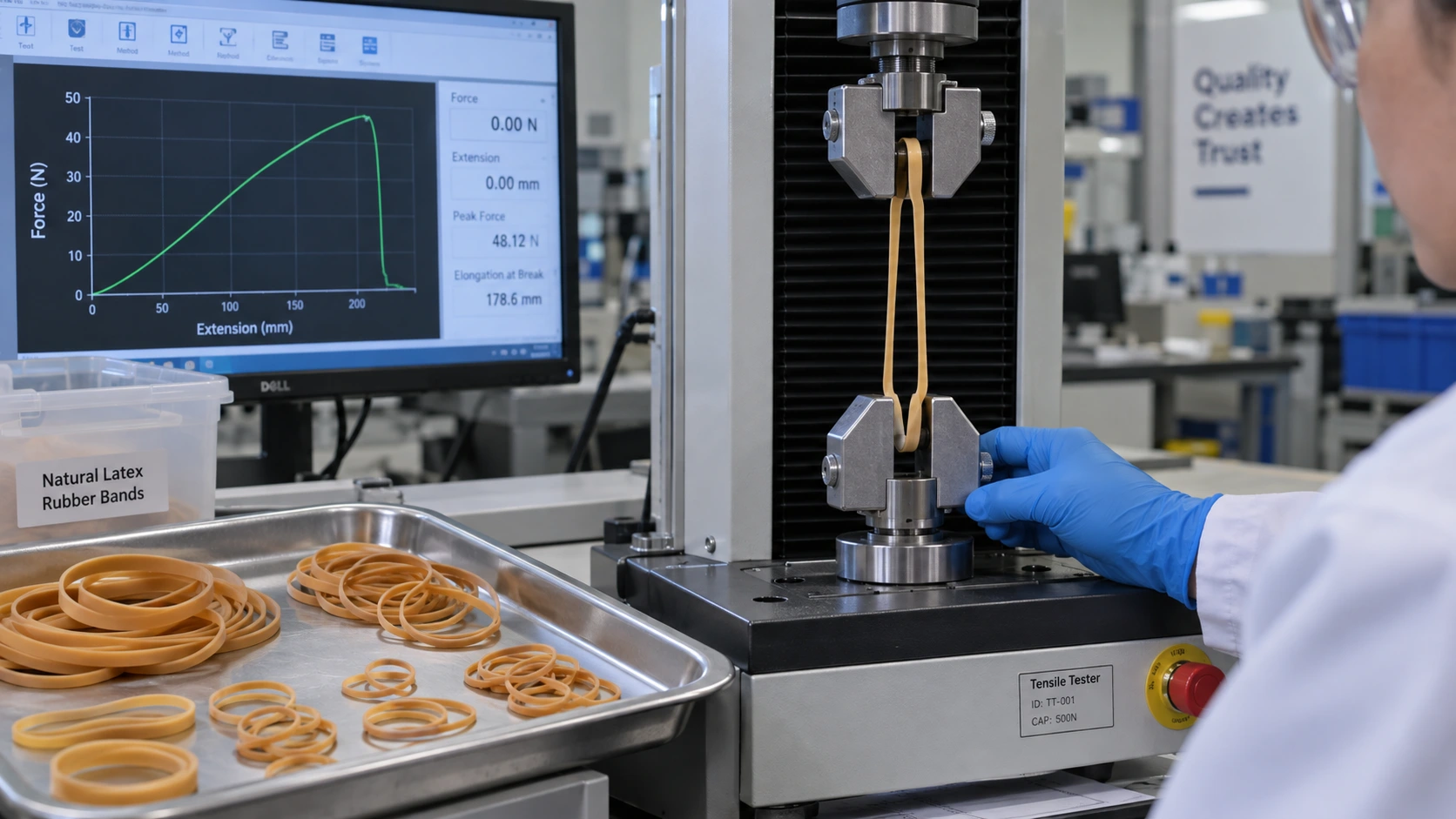
What Tensile Strength Means for a Rubber Band
Tensile strength describes the maximum stress a rubber specimen withstands while being pulled before it breaks. Stress is normally calculated from force divided by the original cross-sectional area. The result is often reported in megapascals (MPa), while a finished rubber band may also be evaluated by force in newtons (N).
For a flat band, width and thickness directly affect the measured force. A wider or thicker band can carry more total force even when its material has the same tensile strength as a narrower band. This is why a force result from one size should not be used as a universal rating for every size.
A proper rubber band tensile test records several points rather than a single number:
- Initial dimensions and gauge length
- Force at a defined extension
- Maximum force before failure
- Elongation at break
- Recovery after unloading
- Permanent deformation after a specified rest period
The stress-strain curve is also useful. The early section shows how easily the band starts to stretch. The middle section indicates how force rises during extension. The final section ends at the break point. Two bands with similar break strength may feel very different in an application because their curves have different shapes.
Elongation and Recovery Are Different Measurements
Elongation at Break
Elongation at break is the percentage increase in gauge length when the specimen fails. It is calculated as:
Elongation at break (%) = (length at break − original length) ÷ original length × 100
A high elongation value usually indicates that the material can stretch substantially before failure, but it does not automatically mean the band will recover well. Test speed, temperature, specimen geometry, conditioning time, and the compound itself all influence the result.
A rubber band elongation result is meaningful only when the test method is defined. The report should identify the original gauge length, specimen shape, crosshead speed, conditioning environment, and whether the sample was cut from a sheet or tested as a finished ring. Without this information, two apparently similar percentages may not be directly comparable.
Elastic Recovery and Permanent Set
Recovery describes what happens after the load is removed. A band that returns close to its original length has good elastic recovery. A band that remains noticeably longer has permanent set, also called residual deformation.
Recovery should be measured after a stated rest period because rubber is viscoelastic. Immediately after unloading, the band may continue to contract. After several minutes or hours, the final length may be different. For repeated-use applications, a recovery test can be more relevant than tensile strength alone.
A practical recovery protocol records the original length, stretches the band to a defined extension, holds it for a defined time, removes the load, and measures the length after a controlled recovery period. Buyers should ask whether the supplier reports immediate recovery, delayed recovery, or both.
How a Rubber Band Break Test Works
A controlled break test should produce repeatable results and protect the specimen from damage caused by the fixture. A typical workflow includes five stages:
- Condition the specimens.Keep samples at a controlled temperature and humidity for a defined period. Rubber properties can shift when the material has been stored in heat, cold, sunlight, or high humidity.
- Measure the starting geometry.Record width, thickness, ring circumference, or gauge length. Use several measurements when the band has molded edges or variable thickness.
- Mount the specimen carefully.Grips should hold the band without cutting, slipping, or creating a sharp stress concentration. Finished rings may require a fixture that applies load evenly around the loop.
- Stretch at a defined rate.Crosshead speed affects the measured force and elongation. The test report should state the speed and the extension sequence, especially when the band is evaluated at a working load before being taken to failure.
- Record the complete result.Capture maximum force, extension at break, failure location, and any visible slippage or edge damage. For development work, retain the force-extension curve rather than only the final value.
A broken sample near the grip may indicate a fixture problem rather than a material problem. Conversely, a break in the center of the gauge section is more useful for evaluating the specimen itself. Repeat tests are essential because one unusually strong or weak sample cannot represent a production lot.
How to Read Test Results for Purchasing
A procurement review should connect each measurement to the application:
- Tensile strength:useful for comparing material resistance to rupture when dimensions and test methods are equivalent.
- Force at working extension:useful for determining whether the band can hold, bundle, seal, or restrain a product.
- Elongation at break:indicates stretch capacity before failure, not the recommended operating extension.
- Recovery:indicates how well the band returns after release and whether it is suitable for repeated cycles.
- Permanent set:helps predict loss of fit after storage, repeated use, or long periods under tension.
- Failure mode:shows whether the sample breaks in the material, at an edge, or near the grip.
For a sourcing decision, specify the load range, target extension, cycle count, temperature, contact environment, and expected storage period. A supplier can then recommend a size and material based on the actual duty rather than a generic “high elastic” description.
Before final approval, request samples from multiple production batches. Compare average values and variation, not only the best individual result. If the band is used in packaging or an assembled product, test the complete application as well as the raw band. Contact surfaces, sharp corners, compression, and twisting can change the real failure risk.
Why Material, Geometry, and Environment Change Results
Natural rubber, latex, synthetic rubber, TPU, and TPR do not respond identically to stretch, temperature, aging, or chemicals. The same nominal size can therefore produce different force and recovery results when the compound changes.
Geometry matters just as much. Width, thickness, inner diameter, loop circumference, edge radius, and molded features all influence stress distribution. A narrow band may feel more flexible but reach its working extension sooner. A thicker band may provide higher force while requiring more effort to stretch.
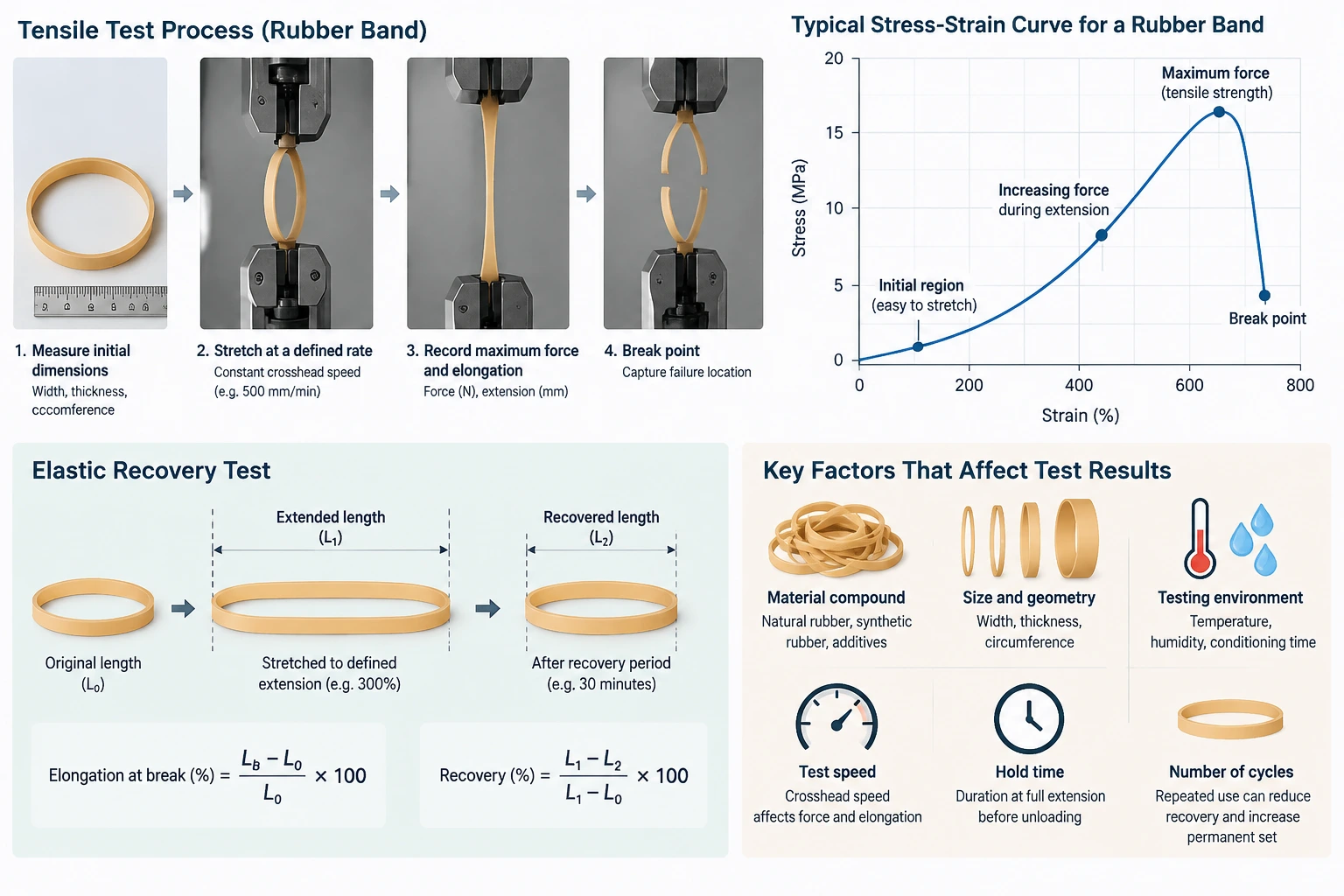
Environmental exposure should be included in qualification testing when relevant. Heat can accelerate aging, while ultraviolet light, oils, solvents, ozone, and repeated abrasion may reduce service life. A test performed on new samples at room temperature cannot by itself predict performance after months of outdoor storage or contact with process fluids.
VIET-Y’s catalog covers rubber and latex products as well as TPU and TPR elastic products. Its product catalog can help buyers identify the appropriate product family before requesting a technical comparison. A listed natural-rubber band product can be used as a starting point for discussing dimensions, material, and intended loading, while the final suitability should be confirmed against application-specific samples and test results.
Questions to Ask a Rubber Band Supplier
A technically useful request for quotation should ask for:
- Material or compound description
- Width, thickness, circumference, and dimensional tolerances
- Force at the intended working extension
- Elongation-at-break test method
- Recovery or permanent-set method
- Conditioning temperature and humidity
- Crosshead speed and fixture type
- Number of samples and batch identification
- Expected storage and operating environment
- Available customization for size, color, packaging, or geometry
The VIET-Y Rubber company profile provides background on the brand and its elastic-product focus. For a production project, send the required dimensions, target load, extension range, quantity, and use environment to the VIET-Y technical team so the supplier can determine which samples and tests are relevant.
Conclusion
Rubber band tensile strength is a useful starting point, but it cannot describe application performance on its own. Elongation at break shows how far a specimen stretches before failure; recovery shows how well it returns; permanent set reveals residual deformation; and a controlled break test exposes weaknesses in the material, geometry, or fixture.
The most reliable purchasing decision combines standardized testing with application samples. Compare bands using the same dimensions, conditioning, extension rate, and recovery period, then verify the result under the loads and environmental conditions the finished product will actually experience.
FAQs
Is tensile strength the same as breaking force?
No. Tensile strength normalizes force by cross-sectional area, while breaking force is the total load at failure. A larger band can show a higher breaking force without having stronger material.
What does elongation at break tell you?
It shows the percentage increase in gauge length when the specimen breaks. It does not define a safe working extension or guarantee good recovery after unloading.
Why does a rubber band stay stretched after use?
Rubber is viscoelastic. Long loading times, high extension, heat, aging, or an unsuitable compound can increase permanent set and reduce recovery.
How many samples should be tested?
The number depends on the product risk, specification, and applicable test method. Multiple specimens from more than one production batch provide a more reliable view than one sample.
What information should be included in an RFQ?
Include band dimensions, material preference, working load, target extension, cycle requirements, operating environment, quantity, packaging needs, and any drawing or sample available.

Latest News
-
Jun. 04, 2026TPU Elastics Safety & Compliance for B2B Food and Hygiene Packaging 2026VIET-Y offers high elastic food grade TPU rubber bands with FDA and EU compliance for food and hygiene packaging. Superior durability, abrasion resistance and safety. Contact us for samples and bulk custom solutions.
-
Jun. 04, 2026Customizable Rubber Bands: Key to B2B Organization and Efficiency in 2026VIET-Y specializes in high-elasticity natural rubber bands and customizable elastic bands for B2B logistics, offices, and supply chains. Durable, color-coded solutions with strong rebound deliver reliable performance and workflow efficiency. Contact us for a free quote.
-
May. 28, 2026Reliable Wholesale Rubber Band Suppliers: B2B Sourcing Guide 2026VIET-Y offers reliable wholesale rubber band solutions with strict quality control, OEM/ODM capability, timely delivery, and ISO certification. This B2B sourcing guide helps buyers select trusted suppliers for sustainable supply chains in 2026.


