

Rubber Bands for Cash Bundling: Best Sizes, Colors, and Break Resistance for Banks and Cash Handling
Time : Oct 09, 2026 View : 14
Rubber bands for cash bundling should hold a defined stack securely without curling notes, damaging edges, or breaking during counting and transport. For banks, cash offices, retailers, casinos, armored transport operators, and cash-in-transit processors, the right specification depends on bundle dimensions, handling frequency, color-control procedures, and required break resistance.
Rubber bands are most useful for internal organization, temporary staging, drawer preparation, and grouping strapped cash. They should not automatically replace printed currency straps where an institution, central bank, customer, or internal procedure requires straps with denomination, value, count, or traceability information.
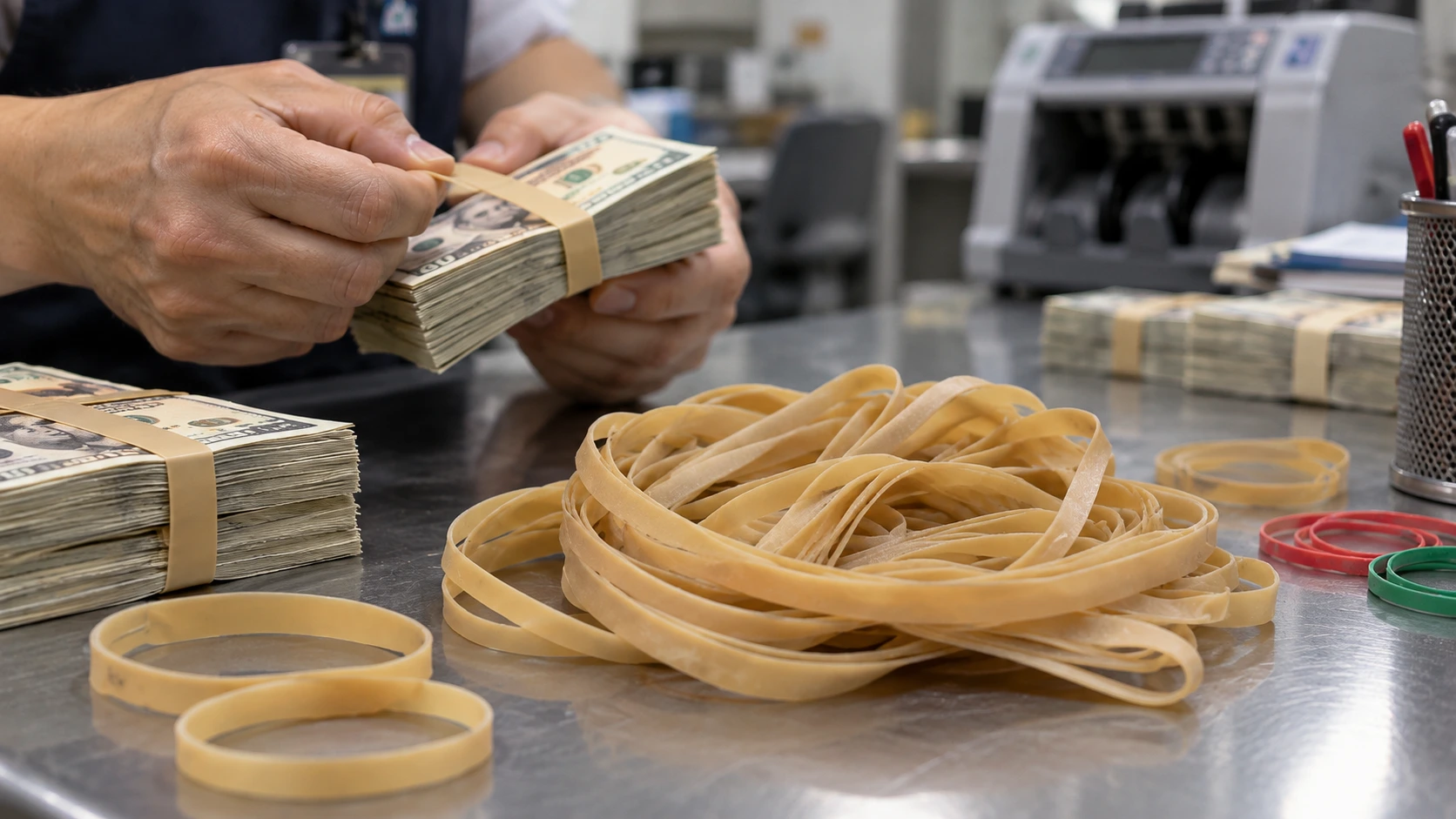
Rubber Bands Versus Currency Straps
A currency strap is normally a paper or polymer band designed to identify and contain a specified group of banknotes. It can carry printed values, denomination information, operator details, or other control data.
A rubber band performs a different job. It applies elastic holding force and can be removed quickly during repeated counting or sorting. This makes it useful for:
-
Temporarily separating counted and uncounted cash
-
Holding small working bundles at teller or cashier stations
-
Grouping multiple strapped units for internal movement
-
Organizing mixed workflow batches before final verification
-
Securing cash-related documents or deposit packets
Rubber bands should be treated as an operational accessory rather than proof that a bundle contains a particular value. Where formal cash-packaging rules apply, approved currency straps, labels, tamper-evident packaging, and institutional procedures take priority.
How to Select the Right Rubber Band Size
A rubber band is usually specified by its lay-flat length, width, and thickness. The lay-flat length is the distance from one folded end to the other when the band is resting flat. Width affects how the load is distributed across the notes, while thickness influences holding force and handling feel.
Measure the Complete Bundle
Measure the bundle’s width and compressed thickness rather than relying only on the number of notes. Note count is an unreliable sizing shortcut because circulation condition, humidity, folds, and compression can change the finished stack.
A practical evaluation should include:
-
The smallest expected bundle
-
The normal operating bundle
-
The largest permitted bundle
-
Any paper strap or wrapper already around the notes
-
The number of times the band will be applied and removed
The band should sit under controlled tension on the smallest bundle without becoming loose. On the largest bundle, it should not require extreme stretching or noticeably bend the notes.
Match Size to the Handling Task
Smaller loops can suit compact note stacks, while larger loops may be appropriate for grouped packets or wider bundles. VIET-Y’s catalog includes a 40 mm natural-rubber ring for financial collection applications and a 7.5 cm rubber band listed for office and financial supplies. These are useful reference points, but suitability still depends on the actual bundle perimeter and required tension.
Procurement teams should request samples in adjacent sizes rather than approving a size from a catalog measurement alone. Testing two or three candidates often reveals meaningful differences in application effort, note compression, grip, and operator preference.
Choose Enough Width to Protect Note Edges
Very narrow bands concentrate force on a small area. This can produce curled edges, deep impressions, or unstable bundles, especially when operators stretch the band aggressively.
A wider band distributes pressure across more of the note surface and is generally easier to see and grasp. However, unnecessary width can increase material use and make removal slower. The correct choice is the narrowest practical width that holds the bundle securely without cutting into or deforming the notes.
Using Color Without Creating Control Errors
Color can improve visual management, but it must have one documented meaning within the operation. Useful applications include identifying processing status, branch, shift, currency type, counting zone, or exception category.
For example, an organization might reserve one color for verified bundles and another for bundles awaiting a second count. That system works only when it is written into the standard operating procedure, displayed at workstations, and applied consistently.
Do not assume that a rubber-band color represents a denomination merely because similar colors appear on currency straps. Official or industry-specific strap conventions may have defined meanings that do not transfer to elastic bands. An undocumented parallel color system can create counting or reconciliation errors.
Natural, translucent, or neutral-colored bands are suitable when color carries no workflow meaning. Distinct custom colors are more useful when the operation has a controlled color matrix. Buyers exploring these options can review VIET-Y’s latex rubber band product range, which includes products with customizable size and color options.
Color trials should also check visibility under the actual lighting used at teller lines, vaults, counting rooms, and night-processing stations. Two colors that appear different in a catalog may be difficult to distinguish under low or tinted light.
What Determines Break Resistance?
“Strong” is not a complete purchasing specification. A band can have high ultimate strength but still be uncomfortable to apply, lose tension after repeated use, or crack during storage. Break resistance should be evaluated as a combination of material behavior, dimensions, production consistency, and operating conditions.

Tensile Strength, Elongation, and Modulus
Tensile strength describes the stress a material can withstand before failure. Elongation at break indicates how far it can stretch before breaking. Modulus or load at a specified elongation helps show how much force an operator must apply during normal use.
These values must be considered together. A band that stretches extensively may still apply insufficient holding force. A high-modulus band may grip firmly but require too much effort or compress the notes excessively. VIET-Y’s guide to rubber-band tensile strength, elongation, modulus, and break force provides additional context for comparing these properties.
Repeated Stretching and Permanent Set
Cash-handling bands may be removed and reapplied several times. A one-time break test therefore does not represent the complete operating cycle.
A useful trial should record whether the band returns close to its original dimensions after repeated use. Bands that remain enlarged can become loose even though they have not visibly broken. Buyers should define a realistic reuse cycle and test retention force after that cycle.
Aging and Storage Conditions
Heat, ultraviolet light, ozone, oils, cleaning chemicals, and prolonged tension may change rubber performance. A band that passes an initial receiving inspection may behave differently after months in a warm storeroom or near electrical equipment.
Keep unopened inventory in controlled, dry storage away from direct sunlight and incompatible chemicals. Use stock rotation, retain batch identification, and investigate any change in color, odor, surface tack, cracking, or elasticity before releasing older stock.
A Practical Qualification Test for Cash Operations
Testing should reproduce the real workflow rather than relying only on supplier data.
Prepare minimum, normal, and maximum bundles using representative notes. Apply each candidate band using the normal operator method and record:
-
Application effort and ease of removal
-
Bundle stability during lifting and movement
-
Curling, marking, or edge damage
-
Slippage after a defined holding period
-
Breakage during repeated application cycles
-
Permanent enlargement after removal
-
Performance after representative storage or conditioning
Use multiple samples from the same batch and, for larger programs, compare more than one production batch. Record failures by mode: snapping during installation, cracking after storage, loosening through permanent set, or slipping because the size was incorrect. This distinction helps determine whether the corrective action involves material, dimensions, storage, or operator technique.
What to Include in an RFQ
A useful RFQ should state the application instead of asking only for “strong money rubber bands.” Include:
-
Minimum, normal, and maximum bundle dimensions
-
Desired lay-flat length, width, and thickness, if already known
-
Required material or latex restrictions
-
Color and the operational meaning assigned to it
-
Expected application and reuse cycles
-
Storage temperature, lighting, and chemical exposure
-
Packaging quantity and labeling requirements
-
Sampling, dimensional tolerance, and batch-test expectations
-
Forecast order quantity and delivery destination
VIET-Y lists natural-rubber products for financial and office uses and offers configurable size and color options on relevant catalog items. Final material, dimensions, tolerances, performance requirements, and packaging should be confirmed for each application before a production order.
Conclusion
The most suitable rubber band for cash bundling is not simply the smallest or strongest available option. It is a band sized to the complete bundle, wide enough to distribute pressure, colored according to a documented workflow, and tested for breakage, permanent set, aging, and repeated handling.
Keep rubber bands within their intended operational role. Use approved currency straps and secure packaging whenever formal identification, transfer, or compliance procedures require them. A controlled sample trial is the most reliable way to balance bundle security, note protection, and operator efficiency.
FAQ
What size rubber band is suitable for a cash bundle?
Measure the bundle’s compressed dimensions and test adjacent band sizes. The selected band should hold the smallest bundle without slipping and fit the largest bundle without excessive stretching or note deformation.
Should rubber-band colors match currency-strap colors?
Not automatically. Rubber-band colors should follow a documented internal control system. Do not assign denomination meanings unless the organization’s approved procedure explicitly defines them.
Are wider rubber bands better for banknotes?
Wider bands distribute pressure more evenly and may reduce concentrated edge damage. Excessive width, however, can add cost and slow removal, so width should be validated through handling tests.
How can buyers compare break resistance?
Compare tensile behavior, elongation, force at working stretch, permanent set, repeated-cycle performance, and aging under expected storage conditions. A single maximum-stretch claim is insufficient.
For an application review or quotation, contact the VIET-Y technical team with the bundle dimensions, preferred material, color-control requirement, expected reuse cycle, packaging format, and order quantity.

Latest News
-
Jun. 04, 2026TPU Elastics Safety & Compliance for B2B Food and Hygiene Packaging 2026VIET-Y offers high elastic food grade TPU rubber bands with FDA and EU compliance for food and hygiene packaging. Superior durability, abrasion resistance and safety. Contact us for samples and bulk custom solutions.
-
Jun. 04, 2026Customizable Rubber Bands: Key to B2B Organization and Efficiency in 2026VIET-Y specializes in high-elasticity natural rubber bands and customizable elastic bands for B2B logistics, offices, and supply chains. Durable, color-coded solutions with strong rebound deliver reliable performance and workflow efficiency. Contact us for a free quote.
-
May. 28, 2026Reliable Wholesale Rubber Band Suppliers: B2B Sourcing Guide 2026VIET-Y offers reliable wholesale rubber band solutions with strict quality control, OEM/ODM capability, timely delivery, and ISO certification. This B2B sourcing guide helps buyers select trusted suppliers for sustainable supply chains in 2026.


