

Recycled Rubber Bands for ESG Buyers: VIET-Y’s Circular Supply Model
Time : Jun 18, 2026 View : 133
Rubber bands look simple. But in large-volume B2B supply, even a basic fastening item can become part of an ESG sourcing review. These versatile products are widely used across multiple industries on a daily basis, including offices, agriculture, packaging lines, retail warehouses and logistics centers.
That is why recycled rubber bands are getting more attention from procurement teams that care about waste reduction and circular supply. The goal is not to turn a rubber band into a luxury product. It is more practical than that. ESG buyers need everyday consumables that still work well, ship reliably, and fit a more responsible purchasing plan.
VIET-Y, as a rubber band supplier focused on rubber band series products and OEM/ODM customization, can support B2B buyers looking for sustainable rubber sourcing options without ignoring performance, cost, and repeat-order stability.

Why ESG Buyers Are Looking Beyond Standard Rubber Bands
Small Packaging Items Still Affect Procurement Footprints
Rubber bands see use in logistics hubs to group parcels. They also help in agriculture to tie bunches of produce. Offices rely on them for everyday organization. When scaled to millions of units per month, their material source and recyclability create a measurable environmental impact. Switching from virgin rubber to recycled rubber bands lets large-volume buyers lower procurement footprints without changing existing workflows.
Circular Economy Thinking Is Entering Everyday B2B Supplies
Circular economy principles such as reuse, recycle, and resource recovery now shape even low-cost consumables. Recycled rubber bands fit well into ESG procurement frameworks. These frameworks push suppliers to minimize waste and turn production residues into new functional materials.
What Recycled Rubber Bands Mean for B2B Procurement
From Production Waste to Reusable Material Value
Recycled rubber bands show the waste-to-value concept in action. Instead of discarding production offcuts or rejected batches, these materials get reprocessed into new elastic products. This approach cuts landfill disposal and conserves natural resources while keeping supply stable for high-volume users.
Balancing Sustainability with Elastic Performance
ESG buyers still expect reliable elasticity, color stability, and consistent sizing. The challenge lies in meeting these mechanical standards with recycled content. Performance must stay intact, especially in packaging or agricultural applications where failure rates need to remain low.
VIET-Y’s Circular Supply Model for Rubber Band Buyers
Rubber Series Products for Practical B2B Use
VIET-Y’s product direction covers multiple elastic categories suitable for industrial and consumer use. These options meet diverse needs from packaging to retail display while supporting sustainable sourcing goals.
Material Options for Different Sustainability Goals
Buyers can choose among several material types depending on sustainability priorities:
| Material Type | Description | ESG Benefit |
| Recycled Rubber | Made from reclaimed rubber waste | Reduces raw material demand |
| Bio-Based Latex | Derived from renewable natural latex | Supports biodegradable sourcing |
| TPU (Thermoplastic Polyurethane) | High-performance thermoplastic polyurethane offering superior durability and elongation | Long lifecycle, non-toxic, and 100% recyclable, reducing frequent replacements |
| TPR (Thermoplastic Rubber) | Soft texture alternative | Enhances recyclability |
This mix allows distributors to build targeted product portfolios aligned with specific ESG metrics.
OEM/ODM Support for ESG-Oriented Product Lines
Customization plays a key role in sustainable branding. OEM&ODM Accepted; Sample lead time 3~5 working days; Production lead time 3 working days for in-stock inventory and 10–15 working days according to customer’s Color & SIZE. VIET-Y supports custom logo printing, eco-label packaging, thickness adjustments, and color selection. Distributors can therefore differentiate their product lines under ESG themes.
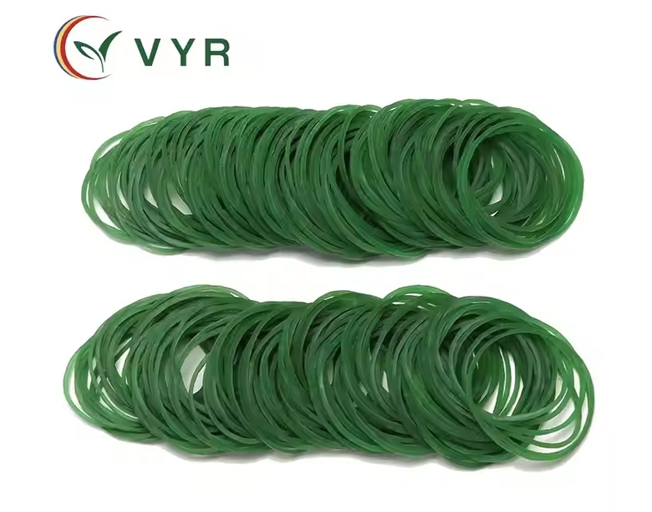
Where Recycled Rubber Bands Fit in Commercial Applications
Packaging and Logistics Bundling
Recycled rubber bands work well for carton grouping or returnable packaging systems where frequent reuse is common. Their flexibility simplifies warehouse sorting while reducing single-use plastic ties.
Agriculture and Fresh Produce Handling
In farms or greenhouses, recycled rubber bands help secure vegetable bundles or flower stems without damaging delicate surfaces. Their elasticity allows quick manual application during harvest operations.
Office, Retail, and Wholesale Supply Channels
Office suppliers can add recycled versions to stationery catalogs. Wholesalers can include them in general-purpose bundling kits. Retailers can promote them as eco-friendly alternatives in everyday packaging solutions.
What ESG Buyers Should Check Before Bulk Orders
Material Source and Documentation
Before confirming bulk orders, buyers should verify supplier documentation on recycled content levels and origin traceability. Batch consistency reports matter when dealing with mixed-material production runs.
Performance Testing for Real Use Conditions
Testing should cover tensile strength, elongation ratio, aging resistance under UV exposure, odor control during storage, and colorfastness after repeated use. These factors affect practical performance in real conditions.
Packaging and Labeling for Sustainable Claims
Sustainability claims must stay transparent. Packaging should list actual recycled content percentages rather than vague terms like “eco-friendly.” Clear labeling builds trust during audits or third-party verifications.
How Sustainable Rubber Sourcing Supports B2B Brand Value
Better Fit for ESG Procurement Programs
Recycled rubber bands align directly with corporate sustainability goals such as waste minimization and responsible material use. They also simplify compliance with internal supplier audits focused on ethical sourcing criteria.
Stronger Differentiation for Distributors
Distributors adopting sustainable rubber sourcing avoid price-only competition. They create premium product lines backed by verified environmental benefits. Institutional buyers worldwide show growing demand for such options.
Why VIET-Y Is Relevant for ESG-Focused Rubber Band Buyers
Product Range Across Multiple Elastic Materials
VIET-Y offers flexibility across several material bases including natural rubber, TPU, TPR, and latex series. Each meets specific market requirements while supporting eco-conscious sourcing decisions.
Quality Control and Export Support for B2B Orders
VIET-Y has achieved the ISO 9001:2015 Quality Management System certification. With its own workshop and warehouse capacity, huge output and storage space can fully meet the various requirements of various customers about the lead time. Years of production experience combined with OEM/ODM capability allow VIET-Y to support global distributors through consistent quality monitoring and timely delivery cycles.
Conclusion
Recycled rubber bands bring circular economy thinking into a product category that is used every day across packaging, logistics, agriculture, retail, and office supply channels. For ESG buyers, the value comes from combining sustainable material choices with reliable stretch, stable quality, practical packaging, and supplier support for repeat orders.
VIET-Y provides B2B customers with options for using rubber bands that have been recycled, rubber band product lines, as well as customized rubber band products based on OEM/ODM requirements. Sample testing, custom specifications, and procurement of bulk rubber band supplies can be coordinated with VIET-Y.
FAQs
Q1: What are recycled rubber bands used for in B2B supply chains?
A: There are many uses for recycled rubber bands including bundling operations for logistics purposes, packaging of agricultural products, retail and wholesale bundling, and office supplies packaging.
Q2: Are recycled rubber bands suitable for ESG procurement programs?
A: Yes, when purchased from a verified supplier of rubber bands like VIET-Y, which can prove documentation regarding the raw materials and quality control measures, such as being ISO9001 compliant, they are suitable for ESG criteria.
Q3: What should buyers check before ordering recycled rubber bands in bulk?
A: Buyers should confirm recycled content authenticity, review tensile strength tests, inspect odor levels after storage periods, evaluate color stability under light exposure, check size tolerances, MOQ terms, delivery times, and available customization services.
Q4: Can recycled rubber bands perform like standard rubber bands?
A: Performance depends largely on formulation control during production. Samples should always be tested under real-use conditions such as repeated stretching or exposure to humidity before full-scale purchasing decisions are made.
Q5: Does VIET-Y offer OEM/ODM support for sustainable rubber band sourcing?
A: Yes. VIET-Y provides tailored design options covering size variations, color schemes, eco-label packaging formats, and branding assistance tailored toward ESG-oriented product lines.

Latest News
-
Jun. 04, 2026TPU Elastics Safety & Compliance for B2B Food and Hygiene Packaging 2026VIET-Y offers high elastic food grade TPU rubber bands with FDA and EU compliance for food and hygiene packaging. Superior durability, abrasion resistance and safety. Contact us for samples and bulk custom solutions.
-
Jun. 04, 2026Customizable Rubber Bands: Key to B2B Organization and Efficiency in 2026VIET-Y specializes in high-elasticity natural rubber bands and customizable elastic bands for B2B logistics, offices, and supply chains. Durable, color-coded solutions with strong rebound deliver reliable performance and workflow efficiency. Contact us for a free quote.
-
May. 28, 2026Reliable Wholesale Rubber Band Suppliers: B2B Sourcing Guide 2026VIET-Y offers reliable wholesale rubber band solutions with strict quality control, OEM/ODM capability, timely delivery, and ISO certification. This B2B sourcing guide helps buyers select trusted suppliers for sustainable supply chains in 2026.


