

How Are Rubber Bands Made? A Factory Process and Quality Control Guide
Time : Oct 08, 2026 View : 17
How are rubber bands made? In a typical factory, a rubber compound is mixed, formed into a tube, cured or stabilized, cut into rings, inspected, and packed. Performance depends on compound consistency, tube dimensions, curing conditions, cut quality, and storage protection. Understanding these controls helps buyers specify products, compare samples, and request evidence linked to the production lot.
What Are Rubber Bands Made From?
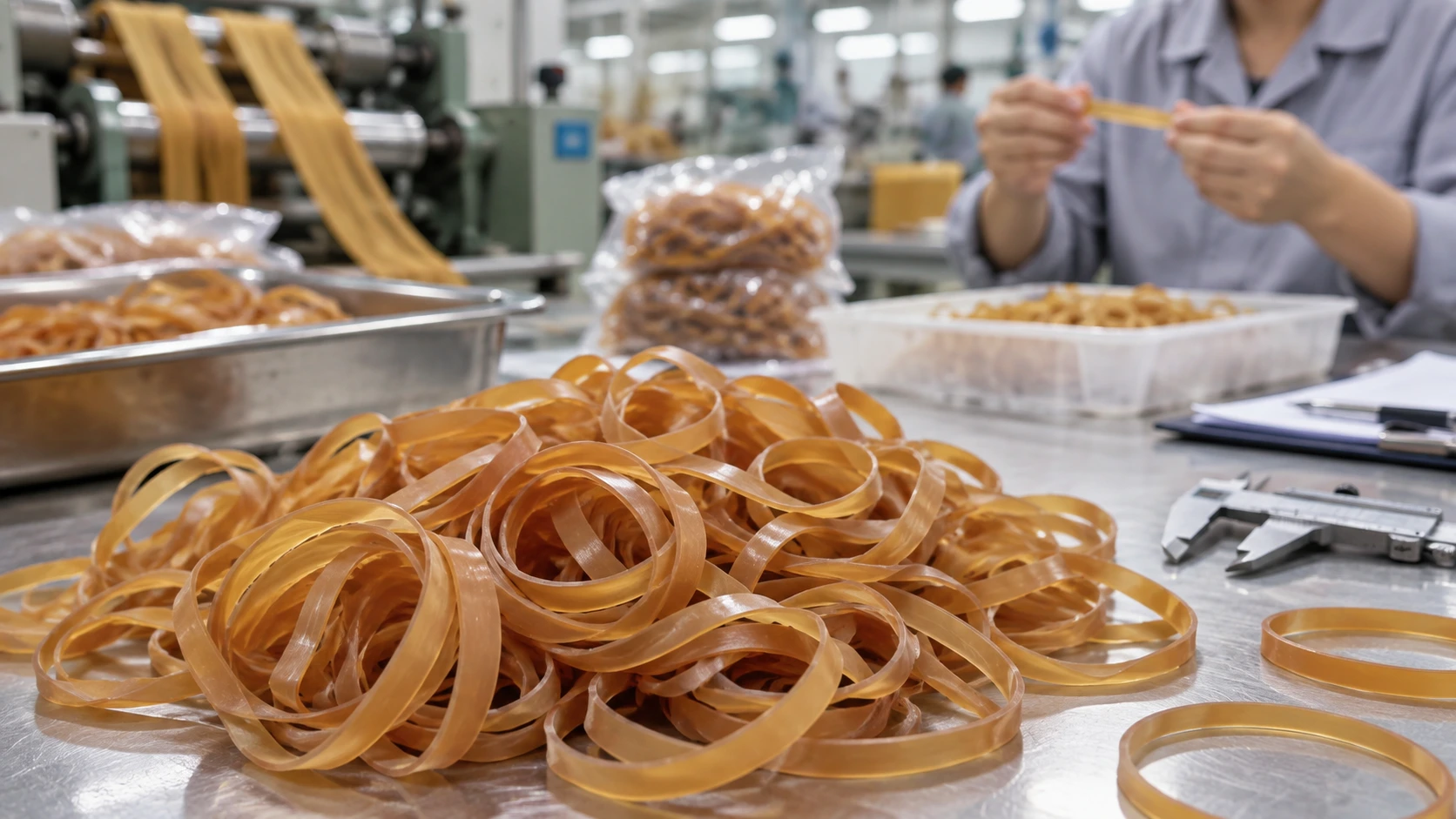
Natural rubber is the elastic polymer obtained from rubber-tree latex. The UCL Institute of Making materials profile provides useful background on rubber bands as a material. Natural rubber may reach a processor as latex concentrate or dry rubber, so “latex” and “natural rubber” are not completely separate materials. Cut bands often use compounded dry natural rubber, while some latex products use a liquid forming route. Formulations may also contain pigments, fillers, antioxidants, processing aids, and a curing system.
Thermoplastic elastomers provide other options. TPR and TPU can be heat-formed and stabilized by cooling rather than following the vulcanization route used for many natural-rubber compounds. Material selection affects feel, color, recovery, temperature response, and environmental resistance. Confirm these properties for the application instead of inferring them from a material name.
VIET-Y, established in 2010, presents rubber, latex, TPR, and TPU product families. Its range includes natural-color, black, and mixed-color products, plus OEM/ODM and customized items. Buyers can review the rubber series and latex series before discussing samples. The categories do not mean every material follows an identical process.
How Are Rubber Bands Manufactured Step by Step?
This typical workflow varies with the compound, geometry, equipment, and customer specification. Buyers should ask the factory to confirm the applicable route.
| Stage | Main purpose | Variables to control | Evidence a buyer can request |
|---|---|---|---|
| Compound preparation | Disperse rubber and formulation ingredients evenly | Batch identity, mixing sequence, time, and temperature | Batch record and raw-material lot references |
| Tube forming | Produce the required inside diameter and wall profile | Die or former condition, feed rate, viscosity, and dimensions | First-piece dimensional inspection |
| Curing or stabilization | Establish elastic recovery and physical properties | Time, temperature, wall thickness, and cooling conditions | Process record linked to the lot |
| Cutting and finishing | Create rings with consistent width and edges | Blade condition, feed tension, cut width, washing, and drying | In-process inspection and retained sample |
| Packing | Protect bands during storage and shipment | Count, lot label, sealing, light, heat, and contamination exposure | Packing specification and carton label |
Compound Preparation
Dry natural rubber is softened and mixed to disperse pigments, protective additives, fillers, and curatives. A liquid-latex route requires different controls for solids, viscosity, and compound condition. Variation can appear as uneven color, weakness, odor, tackiness, or inconsistent recovery. The batch record should identify the formula revision, material lots, mixing conditions, and disposition of nonconforming material.
Tube Forming and Dimensional Control
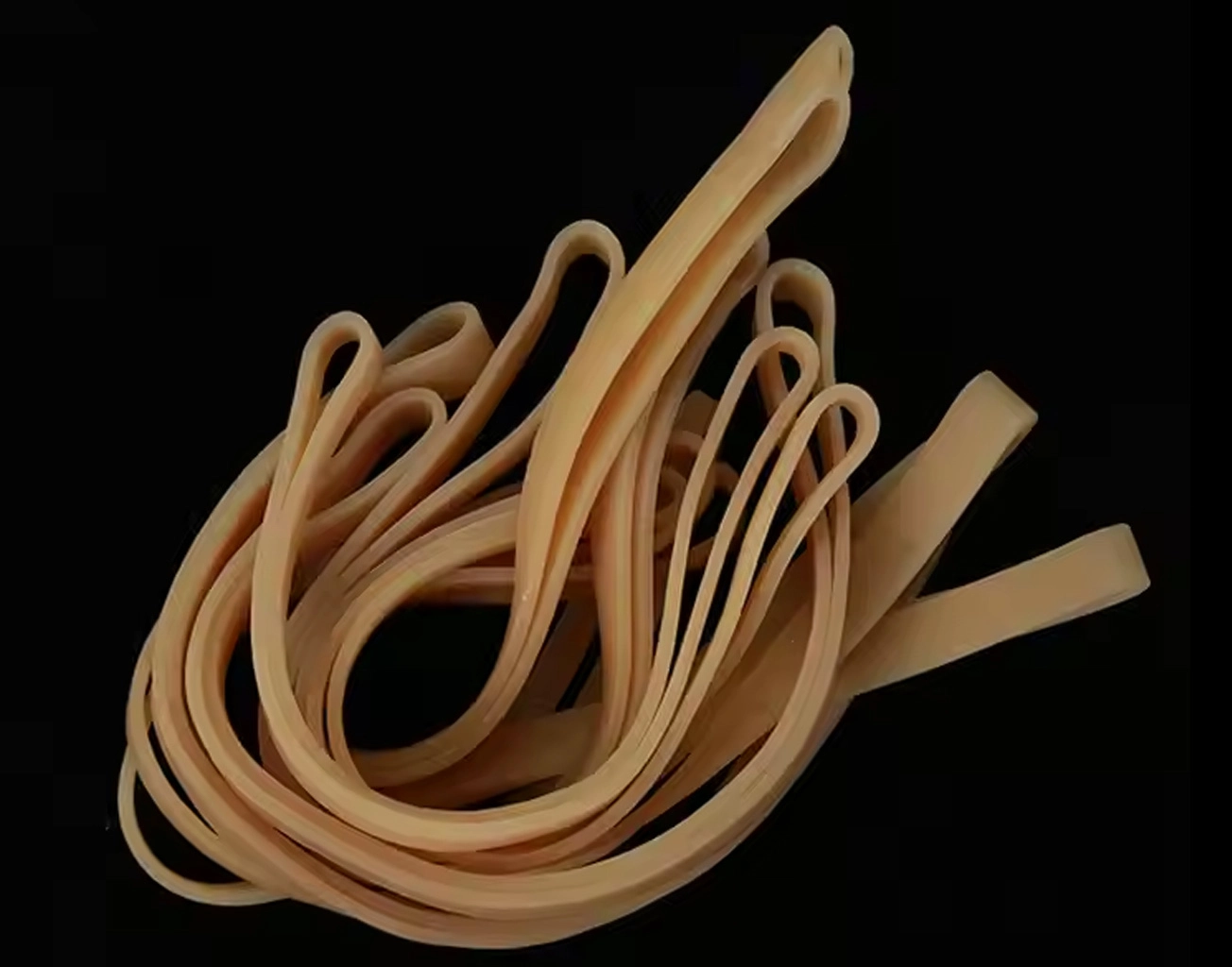
A common dry-rubber route pushes the compound through a die to form a tube, often around a mandrel. A liquid-latex process may build material on a former through coating and drying. Inside diameter, outside diameter, and wall uniformity affect fit, force, and material use. The approved drawing or limit sample should define the measurement method and tolerance for flat length, cut width, and cross-section.
Curing, Cutting, and Finishing
Heat curing creates cross-links in many rubber compounds, establishing extension, strength, and recovery. Insufficient cure may cause softness, tackiness, or weak recovery; excessive cure may reduce extensibility. Thermoplastics require their own forming and cooling controls.
A cutter then slices the tube into rings. Worn blades or unstable feed can cause taper, burrs, or variable width. Washing, drying, surface treatment, printing, and sorting may follow as specified.
How Should Rubber-Band Quality Be Controlled?
Quality control should connect each requirement to a method, frequency, acceptance source, and record. A result such as “high elasticity” is not auditable until the parties define the extension, hold time, recovery time, conditioning, and pass/fail limit.
| Inspection area | What to verify | How to make it auditable |
|---|---|---|
| Incoming materials | Identity, lot, appearance, and relevant condition | Approved supplier information and incoming-inspection record |
| Dimensions | Inside diameter or flat length, width, and thickness | Agreed drawing, calibrated gauge, sampling plan, and tolerances |
| Physical behavior | Elongation, break force, recovery, or permanent set | Defined specimen, test speed, extension, conditioning, and acceptance limit |
| Appearance and color | Cracks, thin edges, contamination, burrs, tackiness, and shade | Approved limit sample, lighting condition, and defect criteria |
| Quantity and packaging | Count or weight, pack unit, seal, label, and carton condition | Packing specification and lot-coded shipment record |
Test values from different methods are not directly comparable because specimen shape, extension rate, conditioning, temperature, and calculation affect the result. VIET-Y’s guide to rubber-band tensile strength relates elongation, modulus, and break force to bulk-order discussions. Final limits must still be agreed for the product and use conditions.
What Common Defects Can Reveal
Early breakage can indicate an unsuitable compound, incomplete dispersion, curing variation, damaged edges, excessive application strain, or poor storage. Stickiness may relate to material aging, surface treatment, heat, contamination, or cure. Fading can involve pigment selection, light exposure, chemicals, or storage conditions. An unusual odor may come from the formulation, processing residues, packaging, or aging.
These symptoms do not identify one root cause by themselves. Record the lot, storage history, application load, temperature, failure location, and time to failure. Then compare affected and retained samples using the same method. The quality troubleshooting guide provides a starting point for organizing breakage, stickiness, odor, and fading complaints.
What Should Buyers Specify Before Requesting a Quote?
A complete RFQ should define the job rather than request only a “strong rubber band.” Include:
-
Application and material preference
-
Inside diameter or flat length, cut width, and thickness
-
Required stretch range, load, recovery, or break-force method
-
Color, surface condition, printing, and acceptable appearance
-
Temperature, humidity, UV, chemical, and storage exposure
-
Destination market and required documentation
-
Sample-approval process, inspection report, and lot traceability
-
Pack unit, labeling, order quantity, target delivery date, and destination
Samples should be evaluated under realistic use and storage conditions. Confirm that production will use the approved material, dimensions, color reference, and test method. For custom work, control the drawing revision and define how a material, tooling, packaging, or process change will be communicated. This prevents subjective phrases such as “high elasticity” or “good quality” from becoming the only acceptance criteria.
How Does VIET-Y Fit a B2B Sourcing Program?
VIET-Y identifies itself as a rubber-band manufacturer with rubber, latex, TPR, and TPU product series. Its published capabilities include an established production operation, product-quality monitoring, and OEM/ODM customization. These are relevant starting points for distributors and buyers that need material, size, or color options, but application suitability should still be verified through an approved sample and an agreed inspection plan.
For a technical fit check, contact the VIET-Y team with the application, drawing or sample, dimensions, material preference, load or extension requirement, environment, packaging, quantity, destination, and target delivery date. Request confirmation of the proposed material, production route, test method, sample process, and lot documentation before approving bulk production.
Conclusion
Rubber-band manufacturing is a controlled conversion process: prepare the compound, form a tube, cure or stabilize it, cut the rings, finish them, inspect the lot, and protect it in packaging. Material choice matters, but process consistency and a measurable specification determine whether the finished band performs as required.
The most effective B2B purchase therefore links each dimension and performance requirement to an agreed method, limit, sample plan, and production record.
FAQs
Are Latex and Natural Rubber the Same Thing?
Natural rubber is the polymer derived from rubber-tree latex. Manufacturers may process it through liquid-latex or dry-rubber routes, depending on the product and factory process.
Are All Rubber Bands Vulcanized?
Many natural-rubber compounds are vulcanized, but TPR and TPU products use thermoplastic forming and cooling routes. The supplier should confirm the process for the selected material.
Which Tests Matter Most for Bulk Rubber Bands?
Dimensions, appearance, elongation, tensile or break force, recovery or permanent set, quantity, and packaging may matter. The application determines which tests and limits are necessary.
What Should a Buyer Approve Before Mass Production?
Approve the material, drawing, color or limit sample, test method, acceptance limits, packaging, labeling, and change-control requirements before releasing a bulk order.

Latest News
-
Jun. 04, 2026TPU Elastics Safety & Compliance for B2B Food and Hygiene Packaging 2026VIET-Y offers high elastic food grade TPU rubber bands with FDA and EU compliance for food and hygiene packaging. Superior durability, abrasion resistance and safety. Contact us for samples and bulk custom solutions.
-
Jun. 04, 2026Customizable Rubber Bands: Key to B2B Organization and Efficiency in 2026VIET-Y specializes in high-elasticity natural rubber bands and customizable elastic bands for B2B logistics, offices, and supply chains. Durable, color-coded solutions with strong rebound deliver reliable performance and workflow efficiency. Contact us for a free quote.
-
May. 28, 2026Reliable Wholesale Rubber Band Suppliers: B2B Sourcing Guide 2026VIET-Y offers reliable wholesale rubber band solutions with strict quality control, OEM/ODM capability, timely delivery, and ISO certification. This B2B sourcing guide helps buyers select trusted suppliers for sustainable supply chains in 2026.


