

Rubber Band Size Chart: Measurements & Selection Guide
Time : Sep 18, 2026 View : 5
Choosing a rubber band by a number printed on a package is not enough for a repeatable B2B purchase. A size such as 32 or 64 is a useful stock identifier, but the fit depends on the band’s lay-flat length, width, thickness, material, and the bundle or part it must hold. This guide explains how to read a rubber band size chart, measure an existing band, and turn the result into a clear specification for production or wholesale sourcing.
What a Rubber Band Size Number Really Means
Commercial rubber bands are commonly identified by a number. The number helps distributors organize standard stock, but it is not a universal engineering dimension. Different suppliers can use different conventions, and the same number may be offered in more than one material or thickness. Treat the number as a starting reference, then confirm physical measurements on the supplier’s chart or sample.
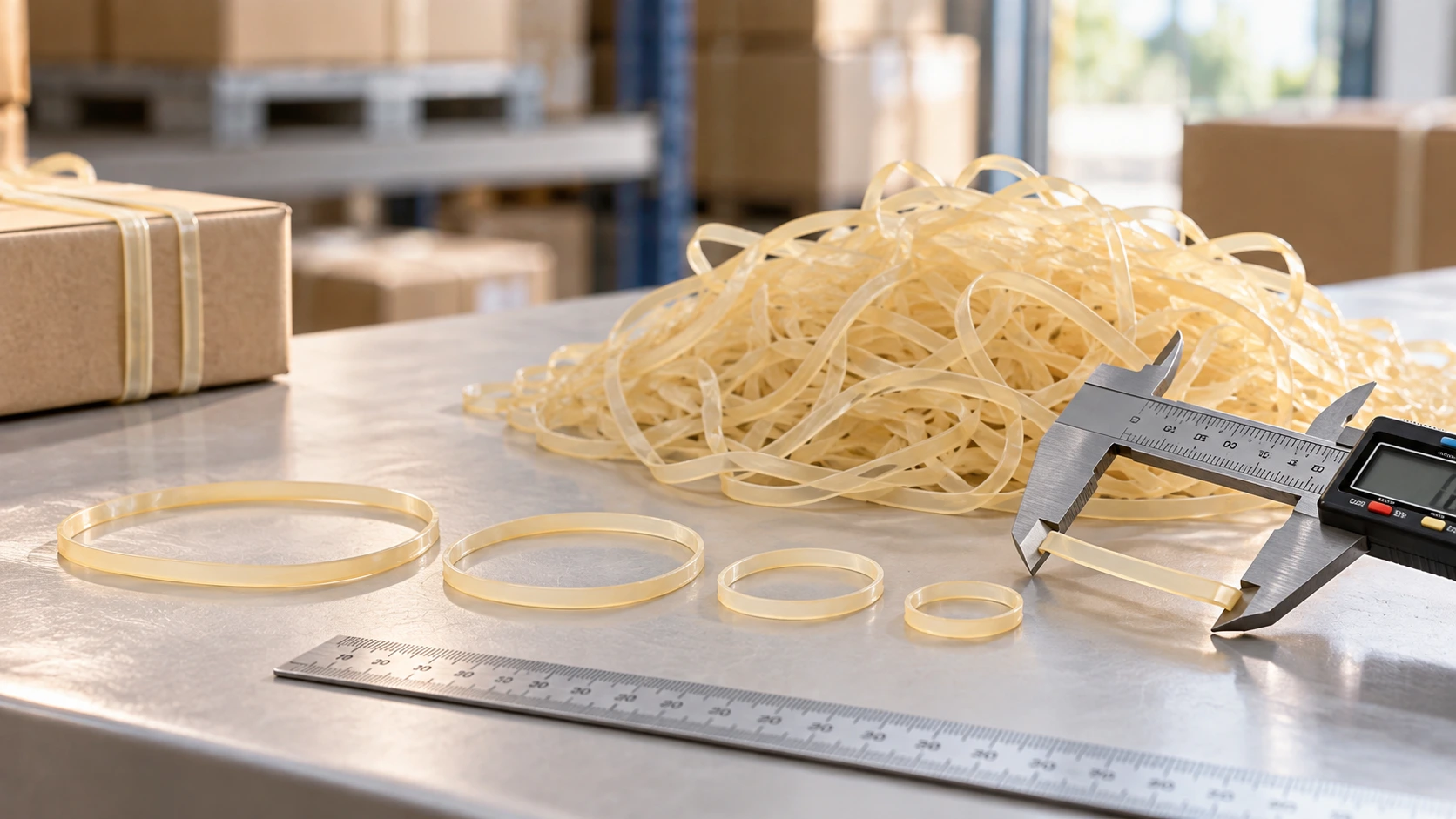
Most charts describe three dimensions:
-
Lay-flat length (L): the length of the band when it is folded flat, measured from one end to the other without stretching.
-
Cut width (W): the width of the strip across the band.
-
Wall thickness (T): the material thickness of the strip.
Some suppliers also list relaxed inside diameter, outside diameter, circumference, or approximate weight count. Tie these values to a defined method: a “length” around the relaxed loop is not lay-flat length.
Standard Rubber Band Sizes: A Practical Reference
The table below shows how common stock numbers are used in purchasing. It is a selection aid, not a substitute for a dimensional drawing.
| Stock identifier | Relative size | Typical purchasing use | Confirm before ordering |
|---|---|---|---|
| #8–#16 | Small to short | Light office bundles, tags, small components | Lay-flat length and narrow width |
| #19–#32 | Small/medium | Documents, retail packs, general bundling | Bundle circumference and required stretch |
| #33–#54 | Medium | Larger document sets, packaging, agricultural ties | Width, thickness, and tear resistance |
| #64–#107 | Long or heavy-duty range | Large bundles, cartons, reusable securing tasks | Relaxed diameter, load, and material compatibility |
| #117 and above | Extra-long or specialty stock | Oversize packages and custom handling systems | Drawing, sample, and application test |
The number sequence is not a strength rating. A wider or thicker band may resist cutting, while a longer band may fit a larger bundle; material and dimensions still need confirmation.
How to Measure a Rubber Band Correctly
Measure a new or undamaged sample at room temperature. Record the units and method so “three inches long” cannot be interpreted as a different dimension.
-
Lay the band flat without pulling it. Align the two sides and remove twists. Measure end to end for lay-flat length. Do not stretch the band during this step.
-
Measure the strip width. Use a ruler or caliper across the band, keeping the tool square to the edge. If the band has a molded profile, take several readings and note the range.
-
Measure thickness. A caliper with light, consistent pressure is preferable. Excessive force compresses elastomer and produces a falsely low value.
-
Check the relaxed loop. If the application is diameter-sensitive, measure the inside diameter while the band is relaxed and circular. This is a supplemental dimension, not a replacement for lay-flat length.
-
Repeat the measurement. Take at least three readings on separate samples. Variation can come from cut tolerance, aging, temperature, or permanent set.
For a quick estimate, lay-flat length is approximately half the relaxed circumference. This is less reliable for thick, oval, pre-stretched, or deformed bands, so use a physical sample for approval.
Matching Band Size to the Bundle or Part
Start with the object, not the stock number. Measure the smallest and largest production bundle, including packaging and edges that can catch a band. Then identify the tension needed to hold parts without crushing, marking, or slipping.
A band normally works best with moderate extension rather than maximum stretch. Too little allows walk-off; too much accelerates fatigue and makes application inconsistent. The acceptable range depends on material, cross-section, temperature, exposure, and cycles.
Use this sequence:
-
Calculate the bundle’s working circumference and compare it with the band’s relaxed circumference.
-
Check whether the width distributes pressure over a fragile surface or concentrates it on an edge.
-
Increase thickness or choose a wider section when cut-through, abrasion, or repeated handling is a concern.
-
Allow clearance for automated applicators, hooks, or guides. A band that fits by hand may not run reliably through equipment.
-
Test the smallest and largest expected bundle, not only a nominal sample.
For food, medical, outdoor, or chemical-facing use, screen the material before sizing. Some users require latex-free construction or resistance to oils, ozone, UV, or cleaning chemicals. A different elastomer may be needed even when dimensions stay the same.

Material and Construction Checks
Size alone cannot predict service life. Ask the supplier to identify the material family, coating, and application restrictions. Natural rubber may suit a bundling task, while a synthetic option may suit a particular exposure. Treat performance statements as application-dependent until confirmed by sample or specification.
Inspect clean edges, uniform width, surface tack, cracks, and odor. For repeat orders, define variation limits for dimensions, color, and visual defects. Include printing, perforation, joining, or special packaging in the drawing because these affect fit and handling.
VIET-Y’s published rubber-band product information identifies natural rubber construction and supports OEM/ODM and customized sizing. That makes a dimensioned sample especially useful when a standard number does not fully describe the requirement. You can review the company’s rubber-band product specification and compare material options through the rubber and latex series.
Common Sizing Mistakes to Avoid
The most frequent error is ordering by number alone. Other mistakes include measuring a stretched band, confusing flat length with circumference, or comparing a worn sample with a new one. Temperature can also change installation feel.
Do not use one supplier’s chart to approve another supplier’s band without checking definitions. Confirm whether dimensions are nominal, minimum, or average; whether thickness is measured under load; and whether diameter is inside or outside. Request a first-article sample for visible surfaces, machinery, or safety-critical handling.
What to Put in an RFQ
An RFQ that includes only “size 64 rubber bands” leaves too much open to interpretation. Provide:
-
Target lay-flat length, width, and thickness, with tolerances
-
Relaxed inside diameter or working circumference, if relevant
-
Material preference and any latex-free, oil-resistant, UV, or temperature requirement
-
Color, finish, print, packaging, and quantity per pack or carton
-
Bundle dimensions, installation method, cycle frequency, and storage conditions
-
A drawing, photos with a scale, or a physical reference sample
For a custom program, ask for the supplier’s measurement standard, sample approval process, and change-control method. VIET-Y presents an OEM/ODM rubber-band solution for defined sizes, logos, or packaging. For a fit check, contact the technical team with dimensions and operating conditions.
Conclusion
A rubber band size chart is most useful when it connects a stock identifier to measurable geometry and a real application. Start with lay-flat length, width, and thickness; verify relaxed diameter and working circumference when needed; then select material and tolerances around the bundle, environment, and handling method. A sample and a complete RFQ will resolve ambiguity faster than a number by itself. With that information, VIET-Y can assess whether a standard natural-rubber band is suitable or whether a customized OEM/ODM specification is more appropriate.
FAQs
Is rubber band size the same as diameter?
No. A stock number may refer to a supplier’s sizing system. Diameter is only one possible dimension and must be identified as relaxed inside or outside diameter.
What are the three measurements on a rubber band size chart?
Most technical charts use lay-flat length, cut width, and wall thickness. Some add diameter, circumference, weight, or piece count.
Can I measure a stretched band?
Measure the band relaxed for ordering dimensions. Stretch measurements can be recorded as a separate operating test, but they should not replace the relaxed size.
Is a thicker band always stronger?
Not necessarily. Strength and service life also depend on material, width, edge quality, temperature, exposure, and extension.
What should I send for a custom rubber-band quote?
Send the three core dimensions, tolerances, material and environmental needs, bundle dimensions, quantity, packaging, and a drawing or sample whenever possible.

Latest News
-
Jun. 04, 2026TPU Elastics Safety & Compliance for B2B Food and Hygiene Packaging 2026VIET-Y offers high elastic food grade TPU rubber bands with FDA and EU compliance for food and hygiene packaging. Superior durability, abrasion resistance and safety. Contact us for samples and bulk custom solutions.
-
Jun. 04, 2026Customizable Rubber Bands: Key to B2B Organization and Efficiency in 2026VIET-Y specializes in high-elasticity natural rubber bands and customizable elastic bands for B2B logistics, offices, and supply chains. Durable, color-coded solutions with strong rebound deliver reliable performance and workflow efficiency. Contact us for a free quote.
-
May. 28, 2026Reliable Wholesale Rubber Band Suppliers: B2B Sourcing Guide 2026VIET-Y offers reliable wholesale rubber band solutions with strict quality control, OEM/ODM capability, timely delivery, and ISO certification. This B2B sourcing guide helps buyers select trusted suppliers for sustainable supply chains in 2026.


