

TPR Elastics for Kids’ Hair Ties: A Buyer’s Guide
Time : Aug 21, 2026 View : 76
TPR elastics can combine a soft rubber-like feel, strong colorability, flexible sizing, and efficient thermoplastic processing. For sellers, importers, distributors, and chain retailers, success depends on controlled specifications for performance, appearance, packaging, labeling, testing, and reorder consistency. VIET-Y supports B2B sourcing as a manufacturer and factory specializing in rubber products and elastic-band production, with TPR and TPU product categories and OEM/ODM capability.
Why TPR Hair Ties Need a Detailed Specification
Define “TPR” Beyond the Product Name
TPR is commonly used as a commercial term for styrenic thermoplastic elastomers within the wider TPE family. Compounds differ in structure, hardness, additives, pigments, and processing, so “TPR” alone does not confirm performance. A purchase specification should identify the declared compound type, hardness range, color system, restricted-substance requirements, and approved sample.
Claims such as “high elasticity” should become measurable checkpoints: dimensions, extension under load, recovery, break force, surface defects, color tolerance, and pack quantity. Published product information already separates inner diameter, folded length, width, and thickness, showing the detail needed for commercial control.
TPR vs. TPU for Kids’ Hair-Tie Programs
Match Material Properties to the Retail Position
TPR can suit value-focused assortments requiring a soft touch, matte or translucent effects, broad color choice, and flexible formulation. TPE compounds can be adjusted for softness, stretch, and color, so approved grades should be compared directly.
TPU offers high elongation, tensile strength, elasticity, abrasion resistance, and good colorability. It may suit thin, glossy, transparent, or higher-durability elastics where tear performance and a clean finish are priorities. Grade chemistry still matters, particularly for humidity exposure, yellowing risk, and transparency.
For a custom label hair ties wholesale program, parallel TPR and TPU samples in identical dimensions provide better evidence than generic claims. Selection should reflect grip, recovery, compliance, and landed cost.
Dimensions, Pull Force, and Seamless Appearance
Build a Size and Performance Matrix
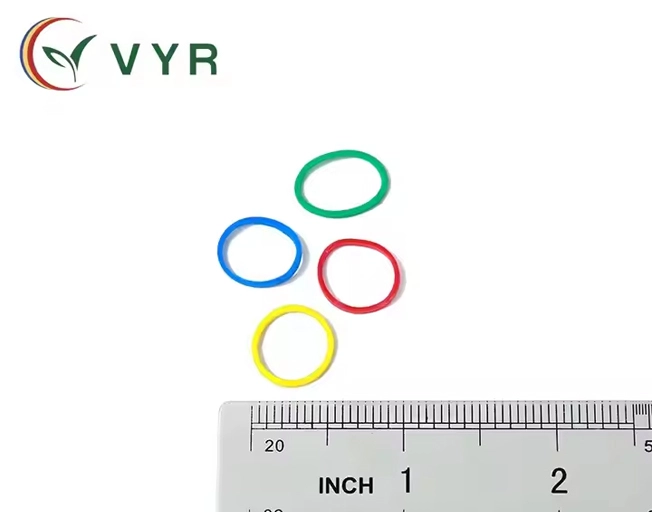
A single diameter rarely serves an entire children’s assortment. A size matrix can separate mini elastics for small sections, standard loops for ponytails, and larger sizes for thicker hair. Each SKU should define nominal inner diameter, width, thickness, unit weight, and tolerance.
Size inconsistency affects comfort and hold. An undersized loop can feel too tight; an oversized loop may provide weak retention. Incoming inspection should sample several bags and cartons.
Pull force defines the effort required to reach a stated extension. Recovery measures how closely the loop returns to its original dimensions. Break force indicates ultimate failure but does not replace cyclic testing, since many complaints result from permanent stretch. A test plan should state extension length, hold time, cycle count, recovery interval, and pass criteria.
Treat “Seamless” as an Inspection Standard
A seamless appearance should cover flash, sharp edges, weld marks, rough gates, bubbles, uneven cross-sections, and tackiness. A fiber-drag or controlled hair-tress test can reveal edges that catch hair even when defects are difficult to see.
A smooth, continuous profile lowers snagging risk and creates a consistent presentation for private label hair ties with custom packaging.
Color Assortments and Reorder Control
Document Color Ratios and Masters
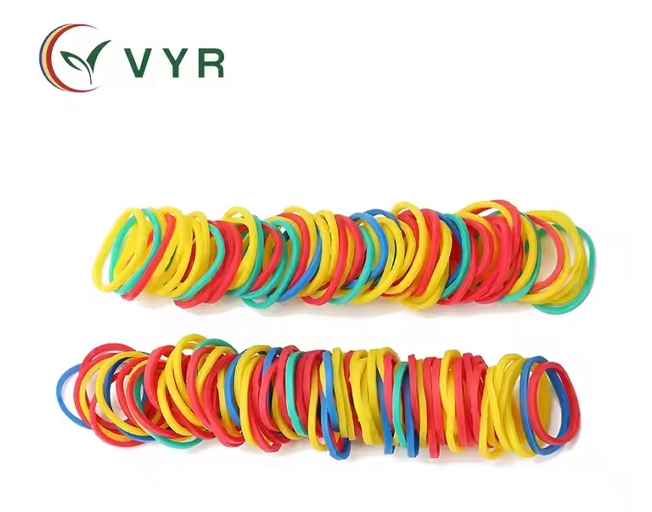
Mixed packs should follow a defined ratio rather than an informal “assorted colors” instruction. Pastel, bright, neutral, and seasonal combinations require separate bills of materials and packing standards. Purchase orders should identify color references, percentages, substitution rules, and display sequence when transparent packaging is used.
For kids hair ties with custom packaging, approved pack-out photos and physical color masters should form part of the production file.
Prevent Reorder Color Drift
Color differences can arise when pigments, base compounds, processing temperatures, or material batches change. A retained master, agreed light source, instrumental color record, and lot identification provide stronger control than screen images or verbal names.
Repeat orders should be checked against both the original master and the latest accepted lot to reduce visible variation across stores.
Packaging Quantity, Age Labels, and Compliance
Confirm Count Accuracy and Retail Readiness
Packaging specifications should state piece count, counting method, package dimensions, barcode placement, carton assortment, weight, and seal requirements. Weight-based packing can be efficient, but a printed piece-count claim requires validation against actual count.
A private label hair accessories supplier should provide pre-production packaging samples showing artwork, warnings, origin statements, batch coding, and barcode readability before bulk printing.
Set Age Grading by Intended Use and Design
Age labeling should reflect intended users, foreseeable use, dimensions, and attached decorative parts. In the United States, applicable children’s products may require third-party testing and a Children’s Product Certificate; products intended for children under three are subject to small-parts restrictions when choking, aspiration, or ingestion hazards exist.
In the European Union, the General Product Safety Regulation has applied since December 13, 2024. Traceability information, technical documentation, responsible economic-operator details, and safety information should be confirmed for the destination market.
Sample Testing and OEM Approval
Establish a Golden-Sample System
The approved sample should be signed, dated, photographed, sealed, and linked to a written specification. Duplicate masters should be held by the buyer and factory. Approval should cover material, dimensions, stretch behavior, color, finish, odor, pack count, artwork, and carton markings.
Sample and production timing should be confirmed in writing, since stock colors and customized sizes or colors may follow different schedules. Published product information distinguishes sample lead time, warehouse availability, and customized production timing.
Test the Main Failure Modes
A useful test plan includes dimensional sampling, cyclic extension, break and permanent-set testing, hair-tress snag evaluation, color comparison, count verification, packaging checks, barcode scans, and retained samples.
Corrective actions should be agreed before production. Hair-catching edges may require tooling changes; premature breakage may require compound or process adjustment; unstable size may indicate molding or cooling variation; reorder color drift may require tighter pigment controls.
OEM Workflow for Private Label Hair Ties
Move From Brief to Replenishment
An OEM brief should include target market, age position, material, dimensions, performance benchmark, color references, assortment ratio, pack count, packaging, forecast, destination, testing requirements, and launch date. A private label hair ties manufacturer can then review manufacturability and prepare an aligned quotation.
The normal sequence includes material confirmation, lab samples, color and artwork approval, pre-production samples, applicable compliance testing, bulk production, final inspection, and retained samples. Replenishment orders should reference the approved specification revision and original color master.
This workflow supports stable custom hair ties with logo packaging while reducing four costly defects: snagging, breakage, inconsistent sizing, and visible reorder color difference.
FAQ
Are TPR Hair Ties Automatically Safer for Children?
No. Material naming alone does not establish safety. Formulation, additives, dimensions, detachable parts, intended age, manufacturing quality, and destination-market rules all affect the assessment.
What Should Appear on a TPR Hair-Tie Quotation?
The quotation should identify material declaration, dimensions, color count, pack quantity, packaging, MOQ, sample and tooling costs, testing scope, lead time, trade terms, and validity period.
How Can Size Inconsistency Be Reduced?
A controlled drawing, defined measurement method, agreed tolerances, multi-cavity validation, in-process checks, and distributed final sampling provide better control than measuring one unit.
What Is the Best Control for Repeat-Order Color?
Physical masters, objective color data, controlled pigments, lot traceability, fixed viewing conditions, and comparison with original and recent production references create the strongest system.
Start a Factory-Direct TPR Hair-Tie Program
Develop Samples, OEM Packaging, and Bulk Supply
VIET-Y is a rubber-products manufacturer and elastic-band factory established in 2010, with dedicated TPR and TPU product categories, customized size and color options, quality monitoring, export experience, and OEM/ODM support.
B2B sellers, distributors, and retail chains can contact VIET-Y with specifications—such as target dimensions, tensile strength requirements, color schemes, packaging quantities, age-labeling needs, testing standards, and projected order volumes—to initiate sample development and obtain factory-direct pricing.

Latest News
-
Jun. 04, 2026TPU Elastics Safety & Compliance for B2B Food and Hygiene Packaging 2026VIET-Y offers high elastic food grade TPU rubber bands with FDA and EU compliance for food and hygiene packaging. Superior durability, abrasion resistance and safety. Contact us for samples and bulk custom solutions.
-
Jun. 04, 2026Customizable Rubber Bands: Key to B2B Organization and Efficiency in 2026VIET-Y specializes in high-elasticity natural rubber bands and customizable elastic bands for B2B logistics, offices, and supply chains. Durable, color-coded solutions with strong rebound deliver reliable performance and workflow efficiency. Contact us for a free quote.
-
May. 28, 2026Reliable Wholesale Rubber Band Suppliers: B2B Sourcing Guide 2026VIET-Y offers reliable wholesale rubber band solutions with strict quality control, OEM/ODM capability, timely delivery, and ISO certification. This B2B sourcing guide helps buyers select trusted suppliers for sustainable supply chains in 2026.


