

Rubber Band Ball Kit Supply Chain: Rubber Bands, Quality Control, Packaging & Lead Times
Time : Aug 13, 2026 View : 81
A commercial rubber band ball kit is not simply a bag of elastic loops. For stationery importers, educational distributors, promotional merchandise companies, contract packers, and private-label buyers, the product depends on a controlled bill of materials, repeatable rubber performance, accurate color assortment, verified packing quantities, and export-ready logistics. Weak control at any stage can create snapping, uneven appearance, incorrect kit counts, aged inventory, or missed launch dates. VIET-Y is a rubber products manufacturer and rubber band factory established in Yiwu, China, manufacturing rubber-band products across rubber, latex, TPU, and TPR material categories, with OEM/ODM, quality-control, and export-service support
What a Rubber Band Ball Kit Supply Chain Must Control
Define the Supply Format Before Quotation
The first sourcing decision is whether the order covers loose rubber bands, a complete assembly kit, or finished assembled balls. Where kit-packing service has been confirmed, the specification may include rubber bands by size and color, a starter core, instructions, an inner pouch, a retail box, labels, and master-carton requirements. Finished-ball requirements such as diameter, weight, roundness, and core construction should only enter the specification when assembled-ball supply has been confirmed.
Each component should have an approved specification, unit of measure, packing quantity, tolerance, and revision number. This distinction prevents a quotation for loose rubber bands or kit components from being mistaken for an offer covering fully assembled rubber band balls.
Build Stability Around Repeat Orders
A reliable rubber band supply chain requires more than one successful sample. Procurement teams should examine raw-material continuity, production capacity, color-batch control, cutting capability, packing-line capacity, and contingency planning. The key question is whether the same kit can be reproduced across replenishment orders without material or visual drift.
Stable supply also depends on documented order processing, inventory control, logistics coordination, and timely production communication. These capabilities become especially important when one SKU is distributed across several markets or replenished throughout a seasonal sales program.
Rubber Band Specifications That Protect Performance
Control Dimensions, Not Just Nominal Size
Rubber bands should be defined by lay-flat length or inside diameter, cut width, thickness, cross-section, weight, and permitted edge defects. Small bands may form early layers, medium bands may build structure, and larger bands may cover the outer diameter efficiently.
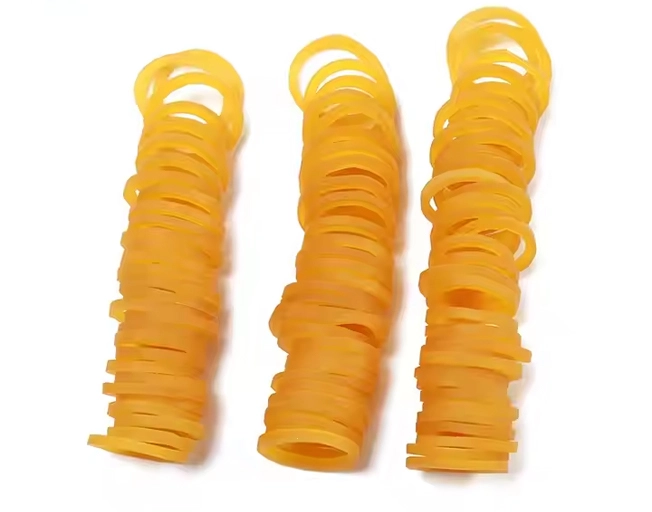
Dimensional consistency affects wrapping tension, assembly speed, appearance, and the number of bands required per kit. A qualified rubber band supplier should confirm tolerances and inspection methods before mass production. Purchase specifications should also state whether assortment quantities are controlled by piece count, net weight, or both.
Verify Elasticity, Recovery, and Aging
Tensile strength is only one performance measure. A sourcing program should also consider elongation, stress at a defined extension, recovery, repeated-wrap breakage, surface grip, odor, and cracking. ISO 37 provides a standardized method for determining tensile stress-strain properties, while ISO 188 covers accelerated aging and heat-resistance testing for vulcanized and thermoplastic rubber materials.
Building sample balls can reveal excessive stiffness, slipping layers, edge cuts, whitening, rapid relaxation, or breakage that a hand stretch may miss. Warm-storage trials may also be appropriate for long export routes or seasonal inventory. The evaluation should reflect the actual wrapping process rather than relying only on laboratory elongation data.

Color Sorting and Assortment Consistency
Approve Color With a Repeatable Reference
Color-sensitive kits should use an approved physical master under defined viewing conditions. For stricter programs, CIELAB values and an agreed color-difference tolerance can supplement visual approval. International colorimetry methods define L*, a*, and b* coordinates and provide a basis for evaluating perceived color differences.
This system is more reliable than informal descriptions such as “bright red” or “light blue,” which can vary between production batches and lighting environments. The approved reference should remain linked to the purchase-order revision used for mass production.
Control the Mix, Not Only Each Shade
A mixed-color rubber band ball kit can look inconsistent even when every shade is acceptable. The assortment ratio should therefore be documented by count or weight, with records for the color batch, target ratio, actual packed ratio, and allowable deviation.
Color sorting should also screen for contamination, faded pieces, oil marks, foreign material, and unrelated sizes. Consistent assortment supports shelf appearance, product photography, promotional campaigns, and repeat-order matching. A color approval process without a controlled mix ratio cannot guarantee a repeatable finished kit.
Quality Control From Raw Material to Final Carton
Establish a Golden Sample and Inspection Plan
A signed golden sample should represent the approved commercial configuration. It may record dimensions, elasticity, color assortment, surface condition, package weight, component count, label position, carton arrangement, and barcode data. Changes in material, pigment, dimensions, or packaging should follow documented approval.
Incoming, in-process, and final inspection should use the same specification. ISO 2859-1 provides lot-by-lot acceptance-sampling plans indexed by an acceptance quality limit, supporting agreed checks for broken bands, wrong colors, incorrect counts, contamination, damaged packaging, or unreadable labels.
Classify Defects and Maintain Traceability
Missing components, unsafe foreign material, incorrect product identity, or severe breakage may be treated as critical or major defects. Minor cosmetic variation within an approved range can be classified separately.
Traceability should connect finished cartons with production dates, raw-material lots, color batches, and packing records. This structure supports complaint analysis, batch containment, corrective action, and more efficient investigation when a distributor reports inconsistent performance.
Packaging Options for Wholesale Programs
Match Packaging to the Sales Channel
Polybag kits can support economical classroom, wholesale, or refill programs. Folding cartons can provide stronger shelf presentation for gift and promotional channels. Institutional packs may prioritize count accuracy, resealability, and efficient case packing.
Packaging development should define inner-pack dimensions, sealing method, label content, instruction format, barcode placement, carton quantity, gross and net weight, and pallet pattern. Right-sized packaging can reduce empty space, carton movement, freight volume, and unnecessary warehouse handling.
Protect Rubber During Storage and Transit
Rubber products should be protected from excessive heat, direct light, ozone sources, moisture, and chemical contamination. ISO 2230 provides guidance for the inspection, packaging, and storage of products made from vulcanized or thermoplastic rubber. Sealed inner packaging, closed cartons, clear lot labels, and first-in-first-out rotation help preserve product condition.
When solid-wood pallets or dunnage are used internationally, applicable phytosanitary requirements should be confirmed. ISPM 15 establishes measures intended to reduce pest risks associated with raw-wood packaging material used in international trade.
Lead Times and Export Delivery Capability
Break Lead Time Into Stages
A professional quotation should separate sampling, material preparation, color matching, production, kit assembly, final inspection, and export booking. Custom pigments, printed packaging, special labels, third-party testing, or complex assortments may extend the schedule.
Procurement planning should identify the approval deadline, production completion date, cargo-ready date, shipping window, and required arrival date. Capacity reservation matters for promotional launches, educational purchasing cycles, and seasonal orders. Production lead time and international transit time should be shown separately rather than combined into one estimated delivery period.
Confirm Trade Terms and Documents
Export execution depends on agreed responsibilities for packing, inland transport, export clearance, freight, insurance, and risk transfer. Incoterms 2020 provides internationally recognized rules for allocating these responsibilities and reducing uncertainty in international sales contracts.
The purchase order should define commercial documents, shipping marks, carton labels, packing-list data, and destination-specific requirements. Pre-shipment carton measurements and weights help reduce freight discrepancies, booking delays, and document amendments. Export capability should therefore be evaluated as part of the rubber band supply chain rather than as a separate activity after production.
FAQ
What rubber bands are suitable for a rubber band ball kit?
Natural rubber bands are often evaluated for stretch, recovery, and grip. Final selection should follow wrapping trials covering breakage, working extension, dimensional consistency, odor, surface condition, and storage performance.
How should rubber band sizes be specified?
A complete specification can include lay-flat length or inside diameter, width, thickness, cross-section, weight, color, dimensional tolerances, and acceptable edge quality. Mixed-size kits should also state the required quantity or weight for each size.
How is color consistency controlled?
Color control can combine an approved physical master, defined viewing conditions, instrument readings when required, documented assortment ratios, and traceable color-batch records.
What packaging formats support B2B programs?
Common formats include sealed polybags, printed retail cartons, institutional multipacks, and bulk refill packs. Selection depends on the distribution channel, presentation requirements, storage conditions, freight efficiency, and private-label specifications.
What information supports an accurate lead-time quotation?
The RFQ should identify material, dimensions, colors, assortment ratio, order quantity, packaging, labeling, testing, destination, trade term, and required cargo-ready date. Complete technical information allows production and export schedules to be evaluated more accurately.
Start a Factory-Direct Rubber Band Ball Kit Program
Factory-Direct OEM Support
For bulk, OEM, and private-label sourcing, VIET-Y itself is the manufacturer and factory, not only a trading intermediary. The factory supports rubber band specification development, custom sizes and colors, sample confirmation, quality inspection, packaging discussions, and export coordination for B2B orders.
Procurement teams can contact VIET-Y with the bill of materials, estimated quantity, packaging format, destination, and delivery window to request a technical review, sample plan, and factory quotation.

Latest News
-
Jun. 04, 2026TPU Elastics Safety & Compliance for B2B Food and Hygiene Packaging 2026VIET-Y offers high elastic food grade TPU rubber bands with FDA and EU compliance for food and hygiene packaging. Superior durability, abrasion resistance and safety. Contact us for samples and bulk custom solutions.
-
Jun. 04, 2026Customizable Rubber Bands: Key to B2B Organization and Efficiency in 2026VIET-Y specializes in high-elasticity natural rubber bands and customizable elastic bands for B2B logistics, offices, and supply chains. Durable, color-coded solutions with strong rebound deliver reliable performance and workflow efficiency. Contact us for a free quote.
-
May. 28, 2026Reliable Wholesale Rubber Band Suppliers: B2B Sourcing Guide 2026VIET-Y offers reliable wholesale rubber band solutions with strict quality control, OEM/ODM capability, timely delivery, and ISO certification. This B2B sourcing guide helps buyers select trusted suppliers for sustainable supply chains in 2026.


