

Latex-Free Rubber Bands for Schools & Clinics Buyer Guide
Time : Jan 09, 2026 View : 85
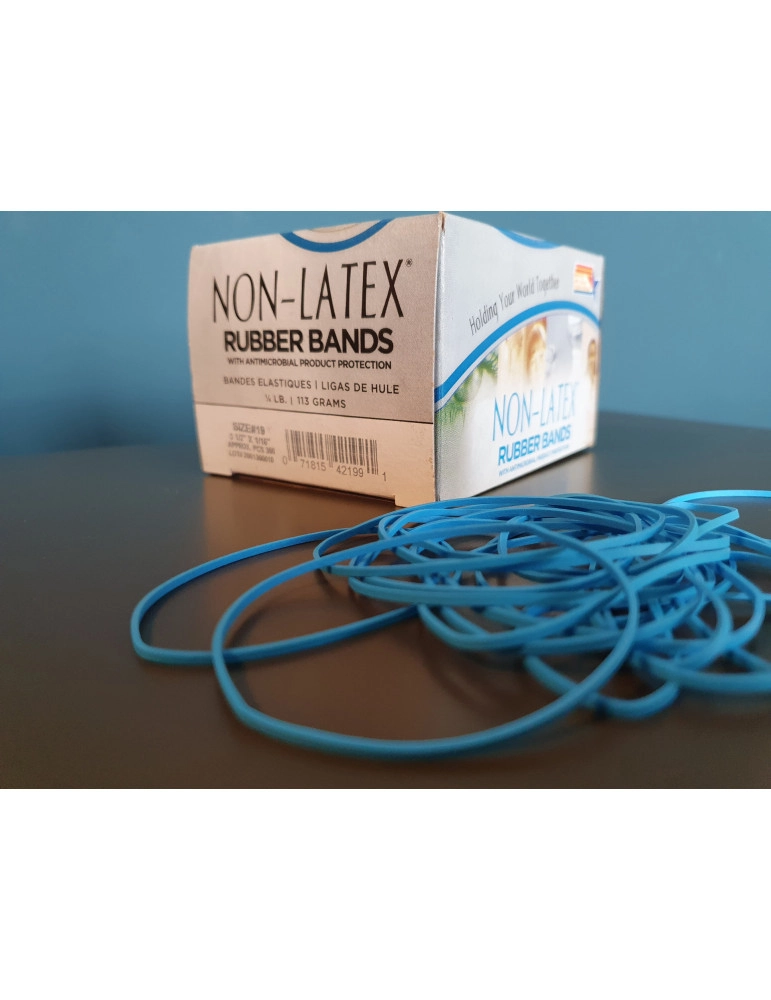
In institutional purchasing, latex free rubber bands often start as a “small” requirement and quickly become a procurement constraint with real operational impact. For buyers supporting schools, public offices, or medical facilities across multiple sites, the risk isn’t theoretical: allergy-related complaints, policy compliance questions, inconsistent stretch from mixed suppliers, and last-minute substitutions that disrupt workflows. The smartest way to manage it is to define what “latex-free” means for your environment, then specify and verify the performance characteristics that actually matter in day-to-day handling.
This guide is written for procurement and operations teams who want a clear, repeatable approach—one you can use in RFQs, incoming inspection, and supplier scorecards.
Why “Latex-Free” Became a Procurement Requirement
In large-scale institutional programs, “latex-free” is usually driven by a mix of health policy, risk management, and user comfort. Schools may be responding to allergy guidance for staff and students. Clinics and outpatient settings often aim to reduce exposure risk in shared environments. Government and corporate offices tend to standardize supplies to avoid avoidable HR and safety issues.
The reality is that many end users never ask what a rubber band is made from—until they have a reason to. Once a sensitivity concern is raised, procurement teams want an option that is easier to defend: a product line positioned as not made with natural rubber latex.
What “Latex-Free” Really Means (And What It Doesn’t)
“Latex-free” is commonly used in the market to mean a product not made with natural rubber latex, which is derived from rubber tree sap, and therefore not expected to contain the latex proteins associated with allergic reactions.
However, labeling language can be messy. Public health commentary has noted that “latex-free” labels can be misleading, and that regulators have preferred more precise phrasing such as “not made with natural rubber latex.”
For buyers managing multi-location supply, the practical takeaway is simple: do not treat “latex-free” as a vague marketing term. Treat it as a sourcing and documentation requirement, paired with a performance requirement.
The procurement-safe way to request “latex-free”
Instead of asking for “latex-free” alone, tie the request to documentation and traceability. Ask the supplier to confirm the product line is not manufactured with natural rubber latex, and to provide relevant statements or material disclosures that your organization can file.
What “latex-free” does not automatically guarantee
Latex-free does not automatically mean “medical grade,” “sterile,” “autoclavable,” or “compatible with every disinfectant.” Those are separate requirements. Some suppliers market non-latex elastic bands as sterilizable (for example, via autoclave or irradiation), but that capability depends on the specific material and the validated process conditions.
Material Options: TPR vs TPU vs Latex (Choosing for Real Use)
If you support schools, clinics, and government offices, you’re typically buying rubber bands for frequent handling: sorting files, bundling kits, organizing supplies, or temporarily securing packaging. What matters most is consistent stretch, predictable recovery, low odor, and low breakage in daily use.
Why TPR is a common latex-free path for institutions
Thermoplastic rubber (TPR) is widely discussed as a synthetic alternative in applications that historically used latex, with different material behavior and processing characteristics than natural rubber. For many institutional buyers, the appeal is consistency and a clear “non-latex” positioning that’s easier to standardize in procurement.
If your goal is a latex-free elastics line that works across classrooms, admin offices, and general clinical handling, TPR is often the most straightforward category to evaluate first.
Where TPU may fit better
Thermoplastic polyurethane (TPU) is often used where buyers want a more durable feel and better wear characteristics under heavy daily handling. If your staff are repeatedly stretching and releasing bands all day—think mailrooms, archive rooms, central supply sorting, or high-traffic admin work—TPU can be worth sampling as an alternative option.
Keep the product family boundaries clear
Many manufacturers offer both latex-based and latex-free series. From a buyer standpoint, that’s not a problem—it’s an advantage—so long as your documentation and SKU mapping are explicit. “Latex-free” should clearly point to the latex-free material line you are purchasing, rather than being applied loosely across unrelated product families.
What to Put in an RFQ: Specs That Reduce Complaints and Returns
For buyers managing multi-site supply, they need to convert “rubber bands” into a controlled specification. The RFQ does not need to be complicated, but it should be complete enough that two different suppliers would quote the same thing.
Define dimensional requirements the way suppliers do
Even basic office rubber bands vary meaningfully by lay-flat length, width, and thickness. Those dimensions influence holding force, breakage rate, and how the band feels in use. When schools complain that bands snap, it’s often because bands are underspecified for the task, not because the supplier “sent bad bands.”
Define performance windows, not marketing adjectives
Instead of saying “strong” or “high quality,” define what success looks like in your environment. In a school office, that might mean a band can be stretched repeatedly without cracking and does not leave residue on paper. In a clinic, it may mean predictable tension for bundling kits, with minimal odor and stable elasticity during normal storage.
Define handling expectations
If bands will be used with gloves, in cooler storage, or near disinfectant wipes, note it. Environment affects elastomer behavior. A product that is fine in a dry office can behave differently when repeatedly handled by gloved hands in a temperature-controlled room.
Sterilization and Clinical Handling: Be Precise Before You Claim Anything
In clinical purchasing, the word “sterilizable” carries a specific meaning and should be treated carefully. Some non-latex elastic bands on the market are explicitly sold for medical settings and described as compatible with sterilization methods such as autoclave steam or irradiation.
For buyers, the safest approach is to treat sterilization as a validated, process-dependent requirement. If your facility intends to sterilize bands, do not rely on a generic category label. Ask for the supplier’s recommended sterilization method, the temperature/time limits they support, and the test basis behind that recommendation. If the supplier cannot provide that, it may still be a perfectly good latex-free band for non-sterile organizational use, but it should not be described internally as “sterilizable.”
This distinction matters in large-scale procurement, because one overbroad claim can turn into a compliance headache later.
Common Institutional Use Cases and How They Change the Best Choice
Procurement teams tend to inherit a wide range of “rubber band tasks,” and the right choice depends on the dominant use case.
Schools and education systems
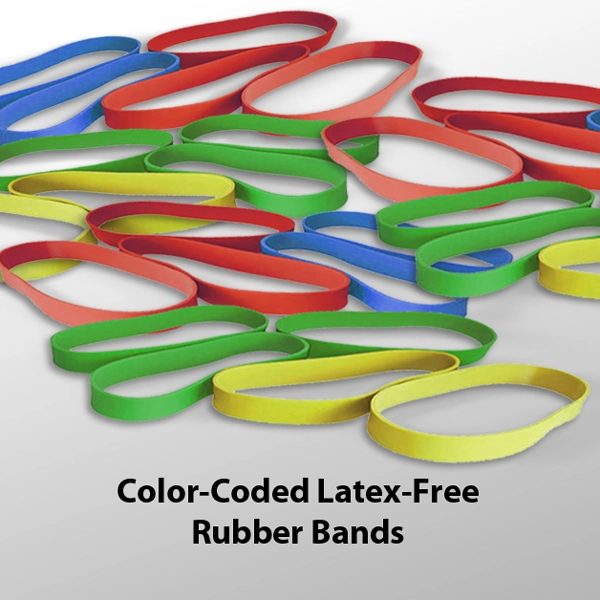
In school admin offices, bands are used for sorting paperwork, bundling folders, and quick organization. Color coding can help with quick sorting, but it’s secondary to consistent stretch and low breakage. Buyers should prioritize predictable tension, low odor, and stable performance in typical indoor storage.
Clinics and outpatient facilities
In clinical settings, bands often support temporary bundling for packaging, labeling, or kit staging. Even when bands are not used in sterile fields, staff typically prefer products that feel consistent, do not shed, and behave predictably during repetitive use. If you plan to sterilize, treat that as its own validated requirement as described above.
Government and corporate offices
In large office procurement, the biggest hidden cost is inconsistency: one batch is fine, the next feels different, users complain, and procurement is asked to re-source. This is where supplier quality systems and lot consistency matter more than shaving cents off a unit cost.
Incoming Inspection and Lot-to-Lot Control Without Turning It Into a Lab Project
For buyers managing multi-location warehouses, incoming inspection should be simple enough to run consistently. The objective is not perfection; it’s catching the obvious mismatches before they spread across multiple sites.
In practice, teams often check basic dimensions against the spec, do a quick stretch-and-recovery check, and monitor breakage during a short handling simulation. If you track complaints, you can also correlate issues to lot numbers and isolate problems faster. This is where traceability and stable manufacturing practices create real value for institutional buyers.
About Zhejiang VIET-Y Rubber Products Co., Ltd.
Zhejiang VIET-Y Rubber Products Co., Ltd. is located in Yiwu City, Zhejiang Province, and the company states it was established in 2010, positioning itself as one of the earlier professional factories in China producing rubber band series products for global markets. The company emphasizes quality assurance via advanced production lines and product quality monitoring and inspection, and also highlights OEM/ODM customization capability—useful for institutional buyers who need standardized sizes, packaging formats, or color coding across multiple sites.
Conclusion
For institutional procurement, latex-free rubber bands are best treated as a controlled supply category, not an interchangeable office commodity. The winning approach is straightforward: define “latex-free” in clear sourcing terms, choose a latex-free material line that fits your dominant use case, and specify dimensions and performance windows that match real handling. If clinical teams request sterilization compatibility, treat it as a validated requirement with defined process limits, not a casual label. In large-scale programs, that discipline is what reduces complaints, prevents re-sourcing cycles, and protects both users and procurement teams.
FAQs
What does “latex free rubber bands” mean for procurement?
In most market usage, latex-free refers to products not made with natural rubber latex, reducing the likelihood of latex-protein exposure concerns. Buyers should still request documentation and avoid relying on vague labeling alone.
Are non latex rubber bands suitable for schools and offices?
Yes, they are commonly purchased for school and office environments where organizations prefer to reduce allergy risk and standardize supplies. The best choice depends on the required holding force, band dimensions, and how frequently staff will handle the bands.
Can latex-free rubber bands be sterilized for medical use?
Some non-latex elastic bands are marketed as compatible with sterilization methods such as autoclave steam or irradiation, but that depends on the specific material and validated conditions. Buyers should request the supplier’s confirmed method and limits before making sterilization claims.
How do I write an RFQ for hypoallergenic rubber bands?
Define the latex-free requirement precisely, then specify lay-flat length, width, and thickness, along with a basic performance expectation such as consistent stretch and low breakage during repetitive handling. If you need color coding or special packaging, include it so the supplier can quote accurately.
What’s the best way to prevent lot-to-lot inconsistency?
Standardize your specification, qualify a supplier with stable quality monitoring, and run simple incoming checks that confirm dimensions and basic stretch/recovery match the approved sample. Over time, tie complaints to lot information to isolate issues quickly.

Latest News
-
Feb. 26, 2026WHY RUBBER BANDS ARE SO IMPORTANT NOWDiscover why rubber bands are essential for office organization, productivity, and cost-effective administrative solutions.
-
Feb. 19, 2026The Safety and Compliance of TPU Elastics in Food Contact and Hygiene ApplicationsDiscover the safety and compliance of TPU elastics for food packaging and hygiene applications, ensuring durability and reliability.
-
Feb. 12, 2026Can TPU Rubber Bands Be Used in Medical or Health-Related ProductsTPU bands, medical products, compression garments, prosthetics, healthcare applications


