

How Many Rubber Bands Are in a Pound or Kilogram? Bulk Quantity Calculator
Time : Oct 01, 2026 View : 28
There is no universal answer to how many rubber bands are in a pound or kilogram. The count depends on each band’s lay-flat length, width, thickness, material, and production tolerance. For a dependable bulk estimate, weigh a representative sample, calculate the average piece weight, and divide the net batch weight by that figure. This method works for a purchasing quote, an inventory count, or a packaging plan.
The Short Answer: Use Average Piece Weight
The calculator is simple:
Estimated pieces = net weight / average weight per band
Use grams for both inputs. One pound equals 453.592 grams, and one kilogram equals 1,000 grams. Therefore:
-
Pieces per pound = 453.592 / average grams per band
-
Pieces per kilogram = 1,000 / average grams per band
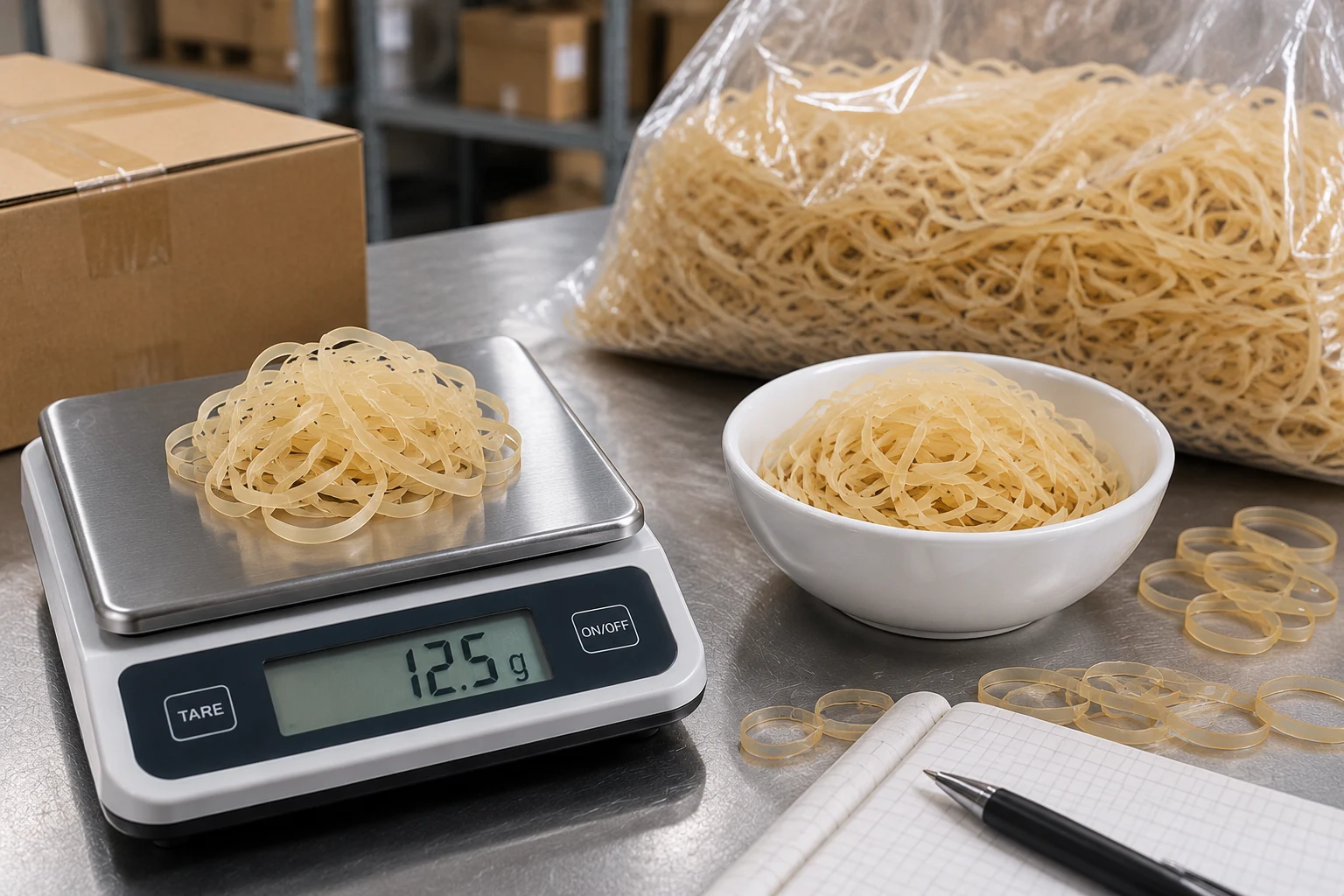
For example, if 25 bands weigh 12.5 grams, the average is 0.5 gram per band. A pound would contain about 907 bands, while a kilogram would contain about 2,000 bands. Those are planning estimates, not a promised pack count.
A Practical Rubber Band Quantity Calculator
The most useful calculator is based on a measured sample rather than a generic online average. Follow these steps before a bulk order:
-
Define one specification. Keep size, cross-section, material, color, and finish consistent. Do not mix #16 and #64 bands or natural rubber and TPU in the same sample.
-
Remove packaging tare. Weigh the empty bag, box, or liner separately. Use net rubber weight only.
-
Count a representative sample. A larger sample reduces the effect of small dimensional differences. Record both the piece count and sample mass.
-
Calculate unit weight. Divide sample mass by sample count. If 100 pieces weigh 48 grams, the average is 0.48 gram per band.
-
Convert the planned batch. Multiply the target pounds by 453.592 or the target kilograms by 1,000, then divide by the average unit weight.
-
Allow an operating tolerance. Use a lower and upper estimate when the supplier’s size or weight tolerance is still being confirmed.
Illustrative Counts by Average Band Weight
The table shows the arithmetic behind a bulk quantity calculator, based on average piece weight rather than a universal numbered-size standard.
| Average weight per band | Approx. pieces per pound | Approx. pieces per kilogram |
|---|---|---|
| 0.05 g | 9,072 | 20,000 |
| 0.10 g | 4,536 | 10,000 |
| 0.20 g | 2,268 | 5,000 |
| 0.50 g | 907 | 2,000 |
| 1.00 g | 454 | 1,000 |
| 2.00 g | 227 | 500 |
To convert the table into a quotation quantity, replace the illustrative weight with the measured unit weight from the approved sample. A supplier should also clarify whether the quoted weight is a nominal target, a minimum net weight, or a commercial tolerance range.
Why the Count Changes So Much
Band dimensions are the first driver. A longer loop contains more material; a wider or thicker cross-section adds still more mass. The same nominal length can therefore produce very different counts per pound when the width or thickness changes. A size chart helps identify the physical specification, but it does not replace a net-weight check. VIET-Y’s rubber band size guide covers the dimensional side of the decision.
Material and formulation also matter. Natural rubber, latex compounds, TPU, and TPR can differ in density, additives, and finished geometry. Color compounds and edge trimming can create small differences between batches. “One kilogram” describes mass, not a guaranteed number of identical loops.
Manufacturing tolerance becomes important at scale. If a band is slightly thicker than the approved sample, the piece count per case falls even when gross weight looks correct. Mixed sizes or colors make the estimate less useful because each subgroup has a different average. For a controlled SKU, keep the specification single-size and document permitted variation.
How to Use the Estimate in Bulk Packaging
Weight-based packing is efficient for large industrial orders, but buyers still need a count expectation. Compare the calculator result with the pack label and production usage rate. If a line consumes 2,000 bands per shift and the sample average is 0.5 gram, the theoretical requirement is about one kilogram per shift before waste.
For “how many rubber bands are in a pound,” use the approved sample.
Count-based packaging is better when each retail or production unit must contain a fixed number. Weight-based packaging is often better when operators transfer bands into bins or when the application consumes material continuously. A mixed assortment should state the ratio by count or weight; otherwise the apparent quantity can drift from one shipment to the next. VIET-Y’s count-versus-weight packaging guide explains why net weight, tare, carton structure, and pack format belong in the same purchasing discussion.
Before comparing prices, confirm these fields:
-
net rubber weight and packaging tare;
-
average piece weight or pieces-per-pack target;
-
band length, width, thickness, and material;
-
acceptable dimensional and count tolerance;
-
single-size versus mixed-size or mixed-color content;
-
inner-pack, master-carton, label, and lot-code requirements.
Turning a Calculator Result Into an RFQ
Send the supplier a sample specification instead of only saying “one pound of rubber bands.” Include a drawing or clear dimensions, material preference, color, application, target weight, expected quantity, and whether the order is sold by count, net weight, or both. If the bands will contact food, medical goods, or sensitive packaging, state the application so suitability can be reviewed against the correct specification.
VIET-Y lists rubber and latex product categories and a latex rubber band product with customizable size and OEM/ODM acceptance. Its rubber series can be a starting point for comparing material and size options. For a new private-label or application-specific program, its custom product development and supply-chain solutions page is the more relevant commercial route than a generic pack-size request.
Ask for a pre-production sample and use the same weighing procedure at receiving. Record piece count, net mass, average unit weight, and observed range so procurement, warehouse, and quality teams share one reference.
Quality Checks That Protect the Estimate
A quantity calculation can be mathematically correct and still be misleading if the sample is not representative. Weigh several samples from different bags and inspect for sticking, cracks, cut edges, odor, or discoloration when those characteristics matter to the application.
For recurring orders, track both pieces and net kilograms consumed. A sudden change in pieces per kilogram can signal a dimension shift. When the application is safety-critical or tightly automated, require the supplier’s inspection method and approval sample before mass production. VIET-Y’s customizable latex rubber band listing shows the product information – material and customizable size – to carry into that approval record.
Conclusion
The answer to “how many rubber bands are in a pound or kilogram?” is a calculation, not a universal lookup value. Measure a consistent sample, remove packaging tare, calculate average grams per band, and divide 453.592 grams or 1,000 grams by that average. Then use a tolerance range and verify the result against the approved size, material, and pack format. This process makes bulk quantity planning clearer for distributors, contract packers, warehouses, and production buyers.
FAQs
How many rubber bands are in one pound?
It depends on band size and average unit weight. Divide 453.592 grams by the measured grams per band.
How many rubber bands are in one kilogram?
Divide 1,000 grams by the measured average weight of one band. A 0.5-gram band gives an estimate of about 2,000 pieces.
Can I estimate quantity from a size number such as #64?
A size number helps identify dimensions, but it is not enough for a guaranteed count. Confirm the actual width, thickness, material, and net weight.
Should bulk bands be sold by count or weight?
Count is useful for fixed-unit packs; weight is efficient for large-volume handling. Many programs use both a net-weight target and a measured piece-count estimate.
What should I send for a custom quotation?
Provide dimensions, material, color, application, target weight or count, packaging format, tolerance, and forecast quantity.
Get an Accurate Rubber Band Count for Your Bulk Order
Need to convert pounds or kilograms into a reliable purchasing quantity? Send VIET-Y your rubber band dimensions, material, sample weight and count, required packaging format, and order volume. The technical team can help verify average piece weight, estimate the quantity per pound or kilogram, and define an appropriate tolerance for your quotation.
Request a bulk quantity calculation and rubber band quotation.

Latest News
-
Jun. 04, 2026TPU Elastics Safety & Compliance for B2B Food and Hygiene Packaging 2026VIET-Y offers high elastic food grade TPU rubber bands with FDA and EU compliance for food and hygiene packaging. Superior durability, abrasion resistance and safety. Contact us for samples and bulk custom solutions.
-
Jun. 04, 2026Customizable Rubber Bands: Key to B2B Organization and Efficiency in 2026VIET-Y specializes in high-elasticity natural rubber bands and customizable elastic bands for B2B logistics, offices, and supply chains. Durable, color-coded solutions with strong rebound deliver reliable performance and workflow efficiency. Contact us for a free quote.
-
May. 28, 2026Reliable Wholesale Rubber Band Suppliers: B2B Sourcing Guide 2026VIET-Y offers reliable wholesale rubber band solutions with strict quality control, OEM/ODM capability, timely delivery, and ISO certification. This B2B sourcing guide helps buyers select trusted suppliers for sustainable supply chains in 2026.


