

Why Do Rubber Bands Break, Stick, Smell, or Fade? A Quality Troubleshooting Guide
Time : Sep 04, 2026 View : 39
Why do rubber bands break soon after arrival while other pieces become sticky, powdery, misshapen, or faded? For importers, distributors, and retail sourcing teams, these failures create sorting costs, rejected packs, and customer complaints. Raw-material variation, vulcanization, pigments, packing pressure, sea-freight heat, and warehouse conditions can interact. Troubleshooting therefore requires a written specification, an approved sample, traceable lots, and an arrival inspection that separates manufacturing defects from logistics damage.
Start with the Failure Pattern, Not a Single Defect
A symptom-to-cause map for purchasing teams
Several defects may share a cause. Heat can accelerate oxidation, odor release, and additive migration while softening a marginally cured compound. The map supports initial investigation; records or laboratory work may still be needed.
|
Observed condition |
Possible production causes |
Possible logistics or storage causes |
Useful receiving check |
|
Breakage or cracking |
Weak compound, poor dispersion, under- or over-curing, thin spots, cuts |
Heat aging, ozone, sunlight, long storage |
Controlled extension and inspection of break surfaces |
|
Sticky surface |
Incomplete cure, excessive process aid, incompatible ingredients |
High container temperature, tight compression, sealed hot packaging |
Compare surface tack across cartons and after conditioning |
|
Powder or pale film |
Ingredient bloom, contamination, oxidation |
Heat cycling, light exposure, aging |
Wipe test, appearance comparison, elasticity check |
|
Strong odor |
Residual curing chemicals, pigment or packaging interaction, contamination |
Volatiles trapped by heat and sealed bags |
Blind comparison with the approved sample |
|
Size variation |
Mold, extrusion, cutting, shrinkage, or sorting variation |
Carton pressure or deformation in transit |
Measure pieces from several carton locations |
|
Fading or color transfer |
Unsuitable pigment system, poor dispersion, formulation interaction |
Light, heat, humidity, packaging contact |
Shade comparison and dry/wet rub screening |
|
Permanent stretch |
Low recovery, unsuitable formulation, cure variation |
Prolonged loading or heat exposure |
Measure initial size, extension, rest time, and recovered size |
Why Do Rubber Bands Break During Normal Use?
Raw materials determine the performance envelope
The compound establishes strength, elongation, recovery, odor, and aging behavior. Variable rubber or latex quality, excessive filler, poor dispersion, unsuitable recycled content, or insufficient protective additives can reduce consistency.
Descriptions such as “high elastic” are not measurable specifications. A purchasing file should identify material, dimensions, intended extension, target force or recovery, appearance, odor expectation, and storage conditions. The supplier’s rubber-band product range can help define the product family, but a signed sample and agreed test method should control approval.
Vulcanization and small defects create failure points
Vulcanization creates the structure that allows rubber to stretch and recover. Under-curing can leave a band soft, tacky, and weak; excessive curing can reduce flexibility. Uneven time or temperature may create different results within one batch.
Breakage can begin at thin sections, rough edges, bubbles, particles, or cuts introduced during demolding and packing. ASTM D412 or ISO 37 may support material tensile testing when the specimen and conditions are suitable. Finished rings often need a product-specific extension or pull-force method because they differ from standard laboratory specimens.
Why Rubber Bands Become Sticky, Powdery, or Smelly
Surface migration is different from simple dirt
A sticky feel may result from incomplete curing or ingredients migrating toward the surface. Heat, pressure, and packing while warm can accelerate migration and cause bands to block together.
A pale deposit may be bloom: compounding ingredients migrating and crystallizing on the surface. Light bloom may not affect function, but heavy or recurring bloom can damage shelf appearance or indicate formulation imbalance. Inspection should record whether it wipes away, returns after conditioning, transfers to packaging, or accompanies cracking.
Odor requires a controlled comparison
Odor can originate from curing agents, pigments, process aids, contamination, or packaging. Airing may reduce trapped volatiles but does not establish acceptability. Comparison samples should receive equal conditioning and be assessed without identifying the lot. Commercially critical applications need an agreed sensory protocol or suitable laboratory screening.
Odor and chemical compliance are separate. Neither mild nor noticeable odor proves compliance status. Compliance requires documentation and testing appropriate to the destination market and application.
Why Size, Color, and Elastic Recovery Vary
Dimensional variation can originate before or after packing
Uneven diameter, lay-flat length, width, or thickness may come from mold variation, unstable extrusion, cutting error, curing shrinkage, or poor sorting. Pressure can worsen the problem when warm bands are compressed into small bags.
Dimensions should be measured after an agreed conditioning period. The plan should identify measurement points, instrument, sample size, nominal value, and tolerance. Individual readings and outliers matter because an average can hide mixed undersized and oversized pieces.
Pigment selection affects fading and transfer
Pigment stability depends on colorant selection, concentration, dispersion, base compound, and exposure. Heat, ultraviolet light, and packaging contact can reveal weaknesses after factory release. Digital photographs should not replace a physical standard or agreed instrument-based tolerance for repeat orders.
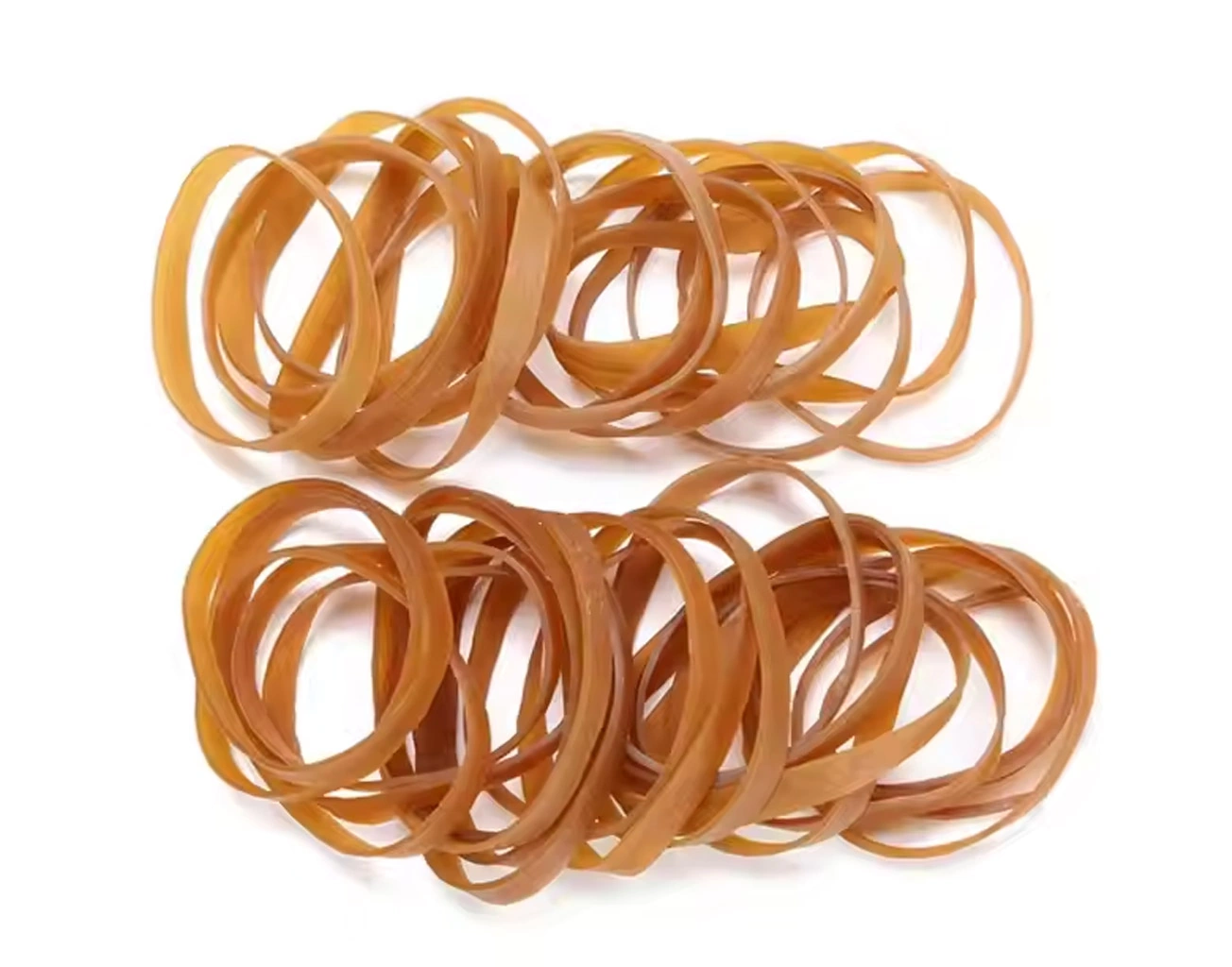
For natural-color or flat products, a latex elastic-band example can establish appearance and format. Approval should still rely on confirmed material, color, dimensions, and performance rather than a web image.
Permanent deformation points to recovery loss
A band that remains enlarged has experienced tensile set. Causes include an unsuitable compound, cure variation, excessive extension, prolonged loading, or heat. Recovery testing should record initial size, extension, hold time, rest time, and final size so results remain comparable.

Packaging, Sea Freight, and Warehouse Risks
A container can accelerate an existing weakness
Ocean freight does not create every defect, but sustained heat can accelerate oxidation, odor, sticking, fading, and deformation. Risk increases when bands are compressed, sealed while warm, exposed to moisture, or stored for long periods.
Packaging specifications should cover inner bags, fill level, carton strength, compression, lot labels, and storage instructions. Barrier controls and packaging interactions should be validated for the actual product.
Warehouse control protects repeatability
Rubber products need protection from excessive heat, sunlight, ozone sources, moisture, oils, solvents, and deformation. ISO 2230 provides guidance on rubber-product storage, packaging, inspection, and records; the applicable edition and material requirements should be confirmed. FIFO rotation and readable lot codes reduce inventory mixing.
The VIET-Y website identifies the company as a rubber-products manufacturer in Yiwu and presents rubber, latex, TPU, and TPR categories with OEM/ODM information. Order documents can translate options into requirements for dimensions, recovery, color, packaging, and traceability.
Arrival Inspection Plan for Imported Rubber Bands
Build evidence before releasing the shipment
Inspection should begin while carton identity and transport evidence remain intact. Damaged, wet, or distorted cartons should be photographed before opening. Purchase-order data, lot numbers, production dates, counts, and available temperature information should be linked to the record.
Samples should cover lots, pallets, cartons, and carton positions. Acceptance criteria should be agreed before shipment; an appropriate AQL framework may be used. Functional failures may require stricter treatment than cosmetic defects.
A practical receiving sequence includes:
- Quarantine and identify each production lot until inspection is complete.
- Condition samples under agreed conditions before final measurements.
- Check cracks, cuts, bubbles, rough edges, tack, bloom, stains, and color variation.
- Measure diameter or length, width, thickness, pack count, and weight where specified.
- Perform controlled extension, breakage, pull-force, and recovery checks using the approved method.
- Compare odor and color with the approved sample under consistent conditions.
- Inspect labels, barcodes, inner bags, seals, cartons, and lot traceability.
- Retain representative accepted and rejected samples for supplier investigation.
Use results to isolate the root cause
Uniform defects may point toward production. Problems concentrated near container doors, crushed cartons, or sun-exposed storage may indicate logistics. Mixed results within a lot suggest process variation or poor sorting. Factory retains help distinguish transport damage from production defects.
Corrective action should address the demonstrated cause. Options include tighter material controls, cure review, improved edge inspection, pigment validation, longer cooling, lower packing pressure, revised cartons, transport monitoring, or better warehouse rotation.
FAQ: Rubber Band Quality Troubleshooting
Why do new rubber bands break immediately?
Immediate breakage may result from weak material, cure imbalance, thin spots, cuts, inclusions, or severe heat aging. Break surfaces, dimensional data, controlled extension results, and comparison with retained samples help narrow the cause.
Is white powder on rubber bands always a rejection issue?
Not always. The deposit may be harmless bloom, but acceptance depends on the application, shelf appearance, transfer risk, odor, and effect on performance. The specification should define an acceptable surface condition.
Can sticky rubber bands recover after cooling?
Some heat-softened bands may feel less tacky after conditioning, while migration or under-curing may persist. Temporary improvement should not replace recovery, blocking, appearance, and functional checks.
How should size inconsistency be reported?
The report should include the measurement method, individual readings, range, average, outliers, carton locations, and lot codes. Photographs alone cannot quantify dimensional variation.
What information is needed before a repeat order?
The order file should preserve material, tolerances, color reference, recovery method, odor expectation, packaging, sampling plan, lot coding, destination market, and the response to nonconforming goods.
Reduce Repeat Failures with a Measurable Sourcing Brief
Turn complaints into acceptance criteria
The most useful answer to why do rubber bands break is not a single material claim but a controlled chain from compound selection and vulcanization through packing, freight, storage, and receiving inspection. Zhejiang VIET-Y Rubber Products Co., Ltd. is a rubber-band manufacturer and factory. An actionable inquiry through the official inquiry page should include the product format, material, dimensions, target extension and recovery, color, odor expectations, packaging, order quantity, destination market, approved sample requirements, OEM/ODM needs, and repeat-order controls.

Latest News
-
Jun. 04, 2026TPU Elastics Safety & Compliance for B2B Food and Hygiene Packaging 2026VIET-Y offers high elastic food grade TPU rubber bands with FDA and EU compliance for food and hygiene packaging. Superior durability, abrasion resistance and safety. Contact us for samples and bulk custom solutions.
-
Jun. 04, 2026Customizable Rubber Bands: Key to B2B Organization and Efficiency in 2026VIET-Y specializes in high-elasticity natural rubber bands and customizable elastic bands for B2B logistics, offices, and supply chains. Durable, color-coded solutions with strong rebound deliver reliable performance and workflow efficiency. Contact us for a free quote.
-
May. 28, 2026Reliable Wholesale Rubber Band Suppliers: B2B Sourcing Guide 2026VIET-Y offers reliable wholesale rubber band solutions with strict quality control, OEM/ODM capability, timely delivery, and ISO certification. This B2B sourcing guide helps buyers select trusted suppliers for sustainable supply chains in 2026.


