

How Are Rubber Bands Made? A Step-by-Step Manufacturing Process for B2B Buyers
Time : Sep 03, 2026 View : 28
For buyers asking how are rubber bands made, the commercial answer involves more than a simple list of production steps. Formulation control, mixing consistency, extrusion stability, curing accuracy, cutting precision, cleanliness, drying capacity, and batch inspection all affect landed cost and repeat-order reliability. A capable supplier should be able to demonstrate how an approved sample will be reproduced across commercial volumes, not merely provide attractive finished pieces.
How Are Rubber Bands Made at Commercial Scale?
The production route buyers should evaluate
Conventional rubber bands are commonly produced through eight connected stages: raw-material formulation, compound mixing, milling, tube extrusion, vulcanization, cutting, cleaning, drying, and final inspection.
The equipment arrangement may differ between factories. Some lines wash the cured tube before cutting, while others clean the individual bands afterward. The sequence is acceptable when the factory documents its controls and the finished batch meets agreed requirements for dimensions, elasticity, cleanliness, appearance, packing, and traceability.
Step 1: Raw-Material Formulation
Compound control establishes performance potential
A conventional formulation may use natural rubber as the main elastic polymer. Depending on the intended application, the compound can also contain curing agents, accelerators, activators, antioxidants, pigments, fillers, and processing aids.
Each ingredient has a manufacturing or performance function. The base polymer provides elasticity. The curing system supports cross-linking during vulcanization. Pigments control color, while antioxidants can help manage deterioration during processing and storage. Fillers and processing aids may influence hardness, surface appearance, production behavior, and cost.
The exact formula is normally proprietary. Procurement teams should therefore evaluate control evidence rather than request every recipe percentage. Useful records include approved raw-material specifications, incoming lot identification, storage conditions, weighing sheets, mixing batch numbers, and retained compound samples.
Products in the Rubber Series illustrate why buyers should specify finished diameter, cut width, wall thickness, color, extension force, recovery, and packaging rather than purchasing only by a general product name.
Latex-derived and solid-rubber products may require different processing assessments. When evaluating the Latex Series, the purchasing specification should confirm the actual material, construction, processing route, dimensions, and intended application.
Thermoplastic rubber is not automatically processed through the same sulfur-vulcanization route as conventional natural rubber. Orders involving the TPR Series should identify the material grade, hardness, dimensions, surface requirements, color standard, and recovery target.
The same distinction applies to the TPU Series. TPU, TPR, latex, and vulcanized rubber should not be treated as interchangeable because their processing conditions, tensile behavior, surface characteristics, temperature response, and aging performance can differ.
Step 2: Mixing and Milling
Uniform dispersion reduces batch variation
The weighed ingredients are blended in an internal mixer or suitable milling equipment. The objective is to distribute pigments, curing chemicals, fillers, and other additives uniformly through the base rubber.
Poor dispersion can create color streaks, hard particles, local weak points, uneven curing, unstable stretch force, or premature breakage. These defects may be difficult to detect in a small presentation sample but can become significant during a large production run.
A factory review should cover ingredient-loading sequence, mixing time, temperature limits, batch size, operator records, and compound-release procedures. Batch identification should remain connected to later extrusion, curing, cutting, and inspection records.
After mixing, the compound is commonly processed into sheets or strips suitable for feeding into the extrusion line. Questionable or rejected compounds should be identified and segregated from approved production material.
Step 3: Extrusion into a Continuous Tube
Tube stability determines important finished dimensions
The prepared compound is fed into an extruder. Pressure forces the rubber through a die, producing a continuous hollow tube that will later be cured and sliced into individual bands.
Extrusion conditions affect outside diameter, inside diameter, wall thickness, weight, and surface quality. Unstable temperature, pressure, feed rate, or die condition can produce dimensional drift, uneven walls, surface lines, or inconsistent material flow.
In-process measurements should be taken at defined intervals. A single final inspection may not reveal gradual variation across a long run. Buyers should look for a documented inspection frequency, calibrated measuring tools, recorded results, and a clear response when measurements approach tolerance limits.
Where mandrels are used, their diameter, surface condition, cleanliness, and release treatment can also influence the finished tube. A factory should be able to connect the correct mandrel and tooling to each approved specification.
Step 4: Vulcanization and Curing
Time and temperature develop usable elasticity
Vulcanization forms cross-links within a conventional rubber compound, changing it from a processable material into an elastic finished product. The cure conditions must suit the formulation, tube dimensions, loading pattern, and equipment.
An under-cured product may show tackiness, weak recovery, low strength, or premature failure. Excessive curing can alter hardness, extensibility, or fatigue behavior. Visual appearance alone cannot confirm that the correct cure has been achieved.
Relevant factory evidence includes approved curing parameters, temperature records, timer controls, batch loading instructions, equipment checks, and traceability. When several tube sizes are processed together, the audit should establish whether the selected conditions remain suitable for each specification.
Step 5: Cutting the Cured Tube
Blade condition affects width and edge quality
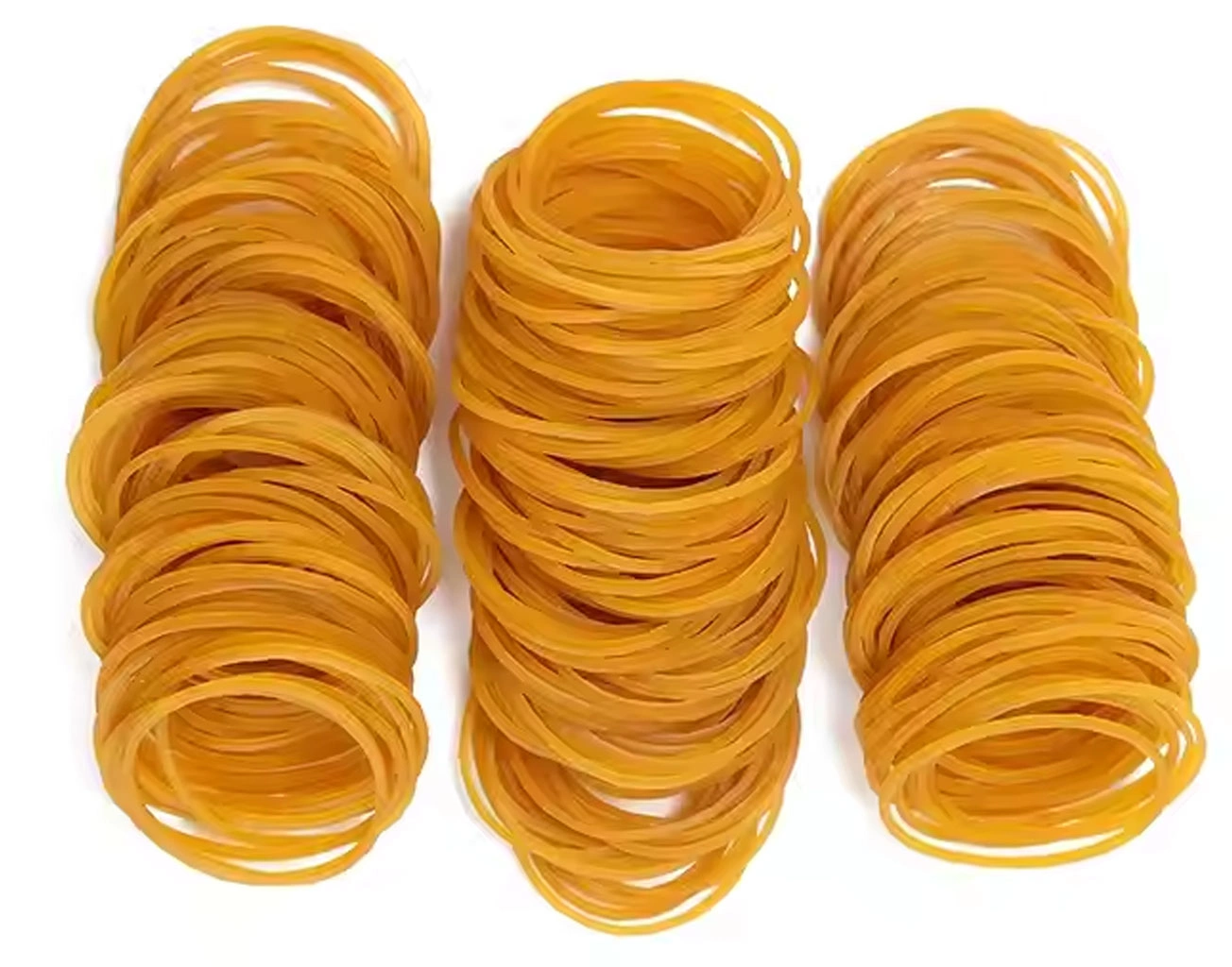
After curing, the tube is removed from the mandrel and fed into cutting equipment. Crosswise slicing produces the individual rubber bands. The cut width affects product weight, appearance, extension force, and the quantity packed by weight.
Blade wear, tube positioning, feed stability, and cutting speed can cause width variation, angled edges, excessive rubber dust, rough surfaces, or partially connected bands. Cutting equipment should therefore be observed during production.
In-process checks should cover band width, edge condition, separated pieces, visible contamination, and dimensional consistency. Documented blade-change criteria provide stronger evidence of control than an informal statement that tooling is replaced when necessary.
Step 6: Cleaning and Drying
Finishing capacity affects cleanliness and delivery performance
Cured tubes may carry release powder or other processing residue. Cutting can also generate rubber dust and loose particles. Cleaning removes these materials before inspection and packing.
A factory may wash the tube before cutting or clean the individual bands after slicing. The audit should verify the actual sequence, cleaning medium, water-change controls, equipment cleanliness, batch separation, and measures used to prevent color or material cross-contamination.
Drying must remove residual moisture without deforming the bands or exposing them to unsuitable heat. Inadequate drying can contribute to clumping, unstable packed weight, staining, carton moisture, or poor shelf presentation.
Washing and drying can become hidden capacity bottlenecks. Several extruders may generate more material than the available washing, drying, sorting, and packing stations can process. Effective capacity should therefore be assessed across the complete line.
Quality Control for Wholesale Rubber Bands
Acceptance criteria should be measurable
Statements such as “high elasticity” or “good quality” are not complete purchasing specifications. Buyers need measurable criteria and controlled test conditions.
Useful finished-product checks may include inside diameter or lay-flat length, cut width, wall thickness, batch weight, color, appearance, odor where relevant, force at a defined extension, elongation at break, break force, recovery, and residual deformation after repeated stretching.
Test results are comparable only when conditioning, specimen geometry, extension speed, holding time, cycle count, and recovery period remain consistent. A pre-shipment report should identify the production lot, sample quantity, equipment, method, results, acceptance limits, inspector, and inspection date.
| Control point | Evidence to review | Main purchasing risk |
|---|---|---|
| Raw materials | Material identity, lot and weighing records | Uncontrolled formulation changes |
| Mixed compound | Batch code, dispersion and release status | Uneven color, cure or elasticity |
| Extruded tube | Diameter, wall thickness and surface records | Unstable finished dimensions |
| Vulcanization | Time, temperature and loading records | Under-curing or over-curing |
| Cutting | Width checks, edge inspection and blade records | Rough edges or size variation |
| Cleaning and drying | Process records and moisture condition | Dust, clumping or contamination |
| Finished bands | Dimensions, force, recovery and break results | Performance failures |
| Packaging | Count or weight, labels and carton checks | Short packs or shipment damage |
How to Verify Factory Production Capacity
Effective capacity is more useful than maximum output
A headline daily-output figure does not prove that a factory can complete a specific order on schedule. Effective capacity depends on material, dimensions, color changes, extrusion speed, curing time, cutting rate, drying capacity, inspection workload, packaging format, maintenance, and rejection levels.
Production records from comparable items are more useful than figures for unrelated products. A capacity review can include machine allocation, shift arrangements, recent output records, normal downtime, changeover time, quality yield, current order loading, and available packing labor.
Bottlenecks deserve particular attention. A factory may operate multiple extruders but have limited curing racks, cutters, dryers, inspectors, or packing stations. Capacity should be mapped from compound preparation through final carton release.
Factory Audit Checklist for Rubber-Band Buyers
Records and controls to verify
-
Approved raw-material suppliers and incoming inspection records
-
Material identification, storage, shelf-life, and lot segregation
-
Controlled weighing and mixing instructions
-
Compound batch traceability and retained samples
-
Extrusion settings and dimensional inspection frequency
-
Mandrel identification, cleaning, and maintenance
-
Vulcanization time and temperature records
-
Cutter condition and blade-replacement criteria
-
Washing, drying, sorting, and contamination controls
-
Calibrated measuring and testing equipment
-
Finished-product sampling plans and acceptance limits
-
Nonconforming-product segregation and disposition
-
Production records for comparable specifications
-
Preventive-maintenance schedules and downtime records
-
Approved packaging samples and label controls
-
Change control for formulas, pigments, tooling, and suppliers
-
Complaint traceability and corrective-action records
-
Repeat-order reference samples and specification revisions
Evaluating the Manufacturer Behind the Process
Company background and order support
Zhejiang VIET-Y Rubber Products Co., Ltd. states on its About Us page that it was established in 2010 and is located in Yiwu, Zhejiang. This information supports initial supplier screening, while production records, measurable specifications, approved samples, and batch-level inspection remain necessary for order approval.
The published Service page describes customized foreign-trade support, procurement, logistics, supply-chain management, customs-related assistance, and customer service. The exact scope, responsibility, commercial terms, and destination-market applicability should be confirmed for each project.
FAQ
What production records should a rubber-band factory provide?
Relevant evidence includes compound batch records, extrusion measurements, curing logs, cutting-width checks, cleaning and drying records, final inspection reports, packaging checks, and traceability from finished cartons back to raw-material lots.
How can elasticity be compared between suppliers?
Samples should be tested under identical conditions. The specification should define extension level, stretching speed, holding period, cycle count, recovery time, sample conditioning, and acceptable force or residual-deformation limits.
Why do rubber bands from different batches feel different?
Possible causes include raw-material variation, inaccurate weighing, poor ingredient dispersion, extrusion drift, inconsistent curing, dimensional variation, or different storage conditions. Approved reference samples and batch-level test reports help identify these differences.
Does every elastic product follow the same production process?
No. Conventional vulcanized rubber, latex-derived products, TPR, and TPU may use different formulations, equipment, curing or thermal-processing conditions, and quality tests. The purchase specification should identify the exact material and manufacturing route.
Prepare a Production-Ready Rubber-Band Inquiry
Information required for sample review and quotation
For sourcing teams researching how are rubber bands made, a production-ready brief should include the application, material, dimensions and tolerances, color reference, extension or force target, test conditions, quantity or forecast, packaging format, destination market, and repeat-order controls. VIET-Y can use these details to evaluate sampling, production quotation, packaging confirmation, and a controlled replenishment plan through Contact.

Latest News
-
Jun. 04, 2026TPU Elastics Safety & Compliance for B2B Food and Hygiene Packaging 2026VIET-Y offers high elastic food grade TPU rubber bands with FDA and EU compliance for food and hygiene packaging. Superior durability, abrasion resistance and safety. Contact us for samples and bulk custom solutions.
-
Jun. 04, 2026Customizable Rubber Bands: Key to B2B Organization and Efficiency in 2026VIET-Y specializes in high-elasticity natural rubber bands and customizable elastic bands for B2B logistics, offices, and supply chains. Durable, color-coded solutions with strong rebound deliver reliable performance and workflow efficiency. Contact us for a free quote.
-
May. 28, 2026Reliable Wholesale Rubber Band Suppliers: B2B Sourcing Guide 2026VIET-Y offers reliable wholesale rubber band solutions with strict quality control, OEM/ODM capability, timely delivery, and ISO certification. This B2B sourcing guide helps buyers select trusted suppliers for sustainable supply chains in 2026.


