

Rubber Band Ball Material Guide for Bulk Buyers and OEM Orders
Time : Jul 23, 2026 View : 89
A rubber band ball may look simple, but commercial rubber band ball kit programs depend on controlled material behavior and a clearly defined supply format. Promotional merchandise distributors, educational supply wholesalers, stationery importers, private-label managers, and contract packers need a ball that stays round, compact, visually consistent, and stable during warehousing and transport. Band composition affects wrapping speed, grip, rebound, color retention, breakage, and cost per accepted unit. Material choice should match polymer type, dimensions, assembly method, and storage conditions rather than price per kilogram alone. VIET-Y is a rubber band manufacturer supporting bulk and OEM programs across rubber, latex, TPU, and TPR product categories.
Why Material Selection Changes Rubber Band Ball Performance
Layering Mechanics and Shape Control
Every loop applies pressure to the layers beneath it. A suitable band must stretch smoothly, hold securely, and recover without cutting into earlier layers. Excessively stiff bands create ridges and slow wrapping, while weak recovery allows a sphere to become oval under carton compression. The best rubber bands for rubber band ball manufacturing are defined by working modulus, recovery, surface grip, cross-section uniformity, and break resistance—not elongation alone.
Total Cost Beyond Unit Price
Procurement comparisons should use cost per accepted kit or finished ball, depending on the confirmed supply format. Low-priced material becomes expensive when it increases assembly time, snaps frequently, requires extra layers, or creates color rejects. Trial data may include bands consumed per sample ball, assembly time during application testing, kit packing accuracy, breakage rate, and dimensional change after warm storage.
Natural Rubber Bands for High-Rebound Construction
Why Natural Rubber Performs Well
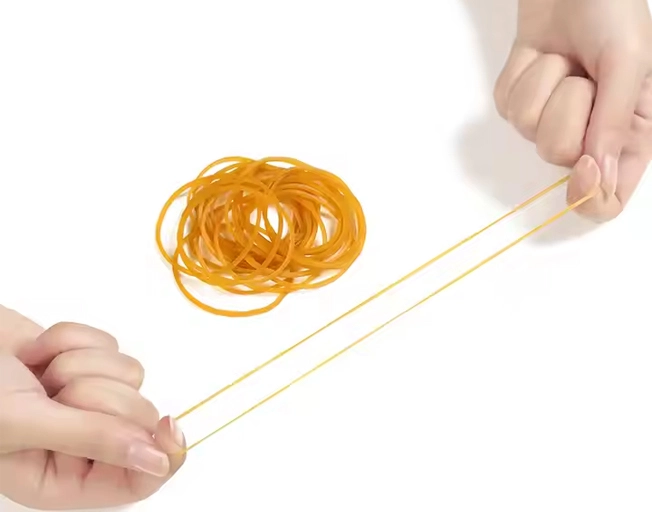
Natural rubber supports large elastic deformation and strong fatigue performance. Its molecular chains can partially crystallize under strain, a mechanism associated with reinforcement and crack-growth resistance. Natural rubber bands for bulk rubber band balls can therefore provide fast wrapping, reliable grip, and lively rebound. The material suits dense designs in which productivity and recovery matter more than a glossy finish.
Aging Risks That Require Control
Natural rubber is vulnerable to oxygen, ozone, heat, and light. Ozone under tensile strain can produce surface cracking, while thermo-oxidative aging changes mechanical response. Sealed inner packaging, limited sunlight, separation from ozone-generating equipment, controlled storage, and first-in-first-out rotation reduce degradation. Heat-aging and ozone-resistance tests can be specified for long export routes or seasonal inventory.
Latex Rubber Bands: Clarify the Commercial Meaning
Latex Is Not Always a Different Polymer
In purchasing language, “latex rubber bands” may describe products made from natural rubber latex, while “natural rubber bands” may describe the same polymer after compounding and vulcanization. Natural rubber is obtained by processing a liquid latex dispersion. A catalog label alone does not establish separate chemistry. OEM qualification should request composition, curing system, process description, and finished-product test data.
Where Thin Latex Constructions Add Value
Thin, flat, or translucent latex constructions may be evaluated for smoother outer layers or decorative patterns, subject to wrapping trials and confirmation of the available product specifications. Their low profile reduces visible steps between wraps, which may suit premium display pieces or private-label sets. Thin sections are more sensitive to nicks and dimensional variation, so inspection should cover width, thickness, edge quality, and assembly breakage. Natural rubber latex also contains proteins associated with allergic reactions, making accurate declarations important for institutional distribution.
TPU Elastics for Color-Led Designs
Surface Appearance and Wear Resistance
Thermoplastic polyurethane is an elastic thermoplastic known for ductility and abrasion resistance; available grades can also support transparent or strongly colored products. For color-focused rubber band ball projects, selected TPU elastics may be considered for decorative applications or kit components, provided that wrapping behavior, recovery, surface condition, and available dimensions are confirmed through samples. Controlled pigmentation can support themed assortments and corporate color programs.
Grade Selection Matters
TPU is a material family, not one performance level. Hardness, chemistry, thickness, and processing history influence stretch response, creep, hydrolysis resistance, and recovery. A loop that works in loose bundling may still fail in a tightly wound ball. A buyer-defined sample evaluation may compare wrapping force, relaxation after agreed intervals, surface blocking, whitening under strain, and diameter retention after warm storage.
Engineering OEM Rubber Bands for Repeatable Assembly
Dimensional Tolerances and Working Extension
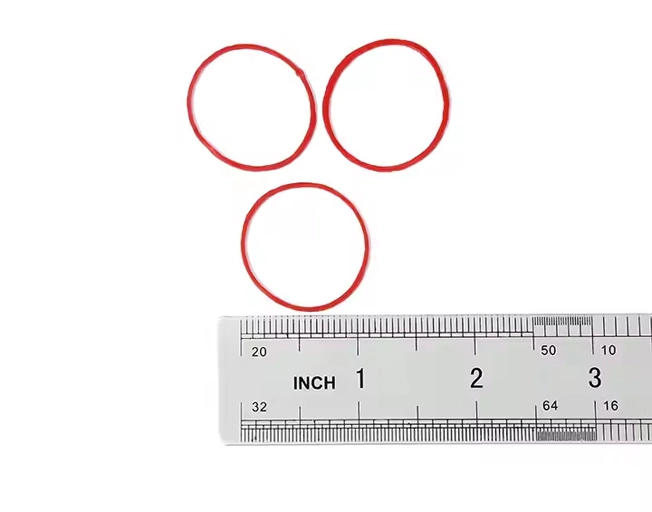
OEM rubber bands for promotional rubber band balls require more than nominal lay-flat length. The drawing should define inside diameter or lay-flat length, width, thickness, cross-section, color, mass tolerance, and acceptable edge defects. Working extension must reflect ball diameter at each stage. Bands near break elongation create inconsistent tension; bands at very low extension may not lock layers securely.
Color Standards and Assortment Ratios
Visual inspection alone is weak for repeat orders. Color approval may begin with an agreed physical sample and defined viewing conditions. For color-critical OEM programs, CIELAB readings and an agreed color-difference tolerance may also be specified when available and confirmed during quotation. ISO colorimetry standards describe L*, a*, and b* coordinates and standardized color-difference calculations. Mixed-color balls also need a documented assortment ratio because accurate individual colors can still create an inconsistent overall appearance when the mix changes.
Bulk Order Quality Control
Golden Samples and Pre-Production Validation
A signed reference sample should reflect the confirmed supply format. For loose rubber bands, it may record dimensions, color, elasticity, package weight, and labeling. For kits, it may also define band assortment and component quantities. Finished-ball diameter, weight, roundness, and core structure should only be included when assembled-ball supply has been confirmed. Depending on the application and destination market, the RFQ may request available data for dimensions, tensile behavior, elongation, tear resistance, and relevant aging performance. Required test methods or third-party testing should be agreed before order confirmation. Standardized methods exist for tensile stress-strain properties, Shore hardness, tear strength, and rebound resilience. Consistent conditioning before comparison helps keep results reproducible.
Lot Inspection and Traceability
For qualified bulk programs, the agreed traceability plan may include raw material batches, color batches, production dates, and packing records. Attribute inspection can use an agreed acceptance-quality-limit plan for broken bands, exposed cores, incorrect diameter, contamination, color mismatch, poor roundness, or damaged packaging. ISO 2859-1 provides lot-by-lot sampling schemes indexed by AQL. Critical defects should carry stricter criteria than cosmetic variation.
FAQ
What material is best for a bulk rubber band ball order?
Natural rubber is often the leading candidate for high-rebound, fast-wrapping construction. Thin latex-based bands may suit smooth decorative layers, while TPU elastics may suit color-led or abrasion-sensitive programs. Final selection should follow finished-ball testing.
How should natural rubber bands be tested before an OEM order?
Testing should cover dimensions, tensile behavior, working extension, repeated stretch recovery, assembly breakage, warm-storage aging, ozone risk where relevant, and diameter retention.
Are latex rubber bands different from natural rubber bands?
Not necessarily. Latex can describe the liquid feedstock used to make natural rubber products. Procurement documents should define polymer composition and process instead of relying on category names.
What controls color consistency in a custom rubber band ball?
A physical master, CIELAB values, an agreed color-difference limit, fixed lighting, and controlled assortment ratios provide a stronger system than visual approval alone.
VIET-Y is a rubber products manufacturer, rubber band product manufacturer, supplier, and factory supporting bulk and OEM requirements across rubber, latex, TPU, and TPR lines; procurement teams can submit target dimensions, colors, packaging, quantity, destination, and test requirements for a customized quotation and sample plan. Contact VIET-Y to discuss material options, OEM specifications, sample confirmation, packaging requirements, and production feasibility for upcoming bulk orders.

Latest News
-
Jun. 04, 2026TPU Elastics Safety & Compliance for B2B Food and Hygiene Packaging 2026VIET-Y offers high elastic food grade TPU rubber bands with FDA and EU compliance for food and hygiene packaging. Superior durability, abrasion resistance and safety. Contact us for samples and bulk custom solutions.
-
Jun. 04, 2026Customizable Rubber Bands: Key to B2B Organization and Efficiency in 2026VIET-Y specializes in high-elasticity natural rubber bands and customizable elastic bands for B2B logistics, offices, and supply chains. Durable, color-coded solutions with strong rebound deliver reliable performance and workflow efficiency. Contact us for a free quote.
-
May. 28, 2026Reliable Wholesale Rubber Band Suppliers: B2B Sourcing Guide 2026VIET-Y offers reliable wholesale rubber band solutions with strict quality control, OEM/ODM capability, timely delivery, and ISO certification. This B2B sourcing guide helps buyers select trusted suppliers for sustainable supply chains in 2026.


